Showing posts with label 4th Grade. Show all posts

Thursday, December 2, 2010

The Strange Case of Origami Yoda

The big question: Is Origami Yoda real?

Well, of course he's real. I mean, he's a real finger puppet made out of a real piece of paper.

But I mean: Is he REAL? Does he really know things? Can he see the future? Does he use the Force?

Or is he just a hoax that fooled a whole bunch of us at McQuarrie Middle School?


So begins The Strange Case of Origami Yoda, by Tom Angleberger. And the central question, of whether Origami Yoda really knows things revolves around his "animator," the school's oddest kid, Dwight. The argument is simply that Dwight is too weird to give good advice, otherwise he wouldn't be so weird, right? And yet Tommy and his friends Kellen and Harvey begin tracking Origami Yoda's patients -- or victims -- to see whether he is the real deal or not.

This book brings up a number of middle school issues -- the kid who cries in P.E., the kids with the awful nickname, the kid dealing with an embarrassing crisis, the kid who wants to see an R-rated movie his parents have nixed, the boy who likes the girl who might not like him -- each handled by Origami Yoda. It's nicely done, all woven neatly into the mystery of Origami Yoda, which makes it more factual and less melodramatic than it might have been.


I think this one will play equally well with boys and girls, but especially with boys for a couple reasons. There's the obvious Star Wars theme, which will appeal to boys, it's loaded with doodles ala Wimpy Kid, and the main characters are all boys. Each chapter is a first person account by Tommy or one of his friends; a few are also by girls they know, but most of the story is told by boys. This would make an excellent Christmas gift for 7-12 year olds on your list, especially if they're boys.

The writing style is easier than I expected: Accelerated Reader puts it at a 4.7 (4th grade and 7 months) which seems about right. My 7 year old and my 9 year old read it over the holiday weekend and both really liked it. They especially liked the instructions at the back of the book for folding your own Origami Yoda. Having spent last Saturday folding little paper Yodas, I can offer you this advice if you find yourself in a similar situation: start with half of an 8.5 x 11 sheet of paper cut or torn neatly to a 5.5 x 8.5 rectangle, then follow the approximate proportions shown in the diagrams instead of the measurements as they didn't actually work that well. The author's website offers instructions for folding an origami Yoda like the one on the cover if you're up for a challenge.

Get this book you must. Enjoy it you will.

Thursday, November 18, 2010

Great Authors: Jean Ferris


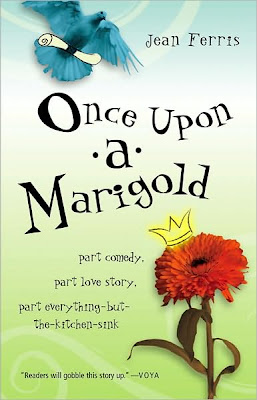
Jean Ferris is probably best known for Once Upon a Marigold and its sequel Twice Upon a Marigold, her updated fairy tales about a mind-reading princess, a runaway boy and the dwarf who cares for him, an evil queen, and the tooth fairy. However, Ms. Ferris has been around for quite a while and is deserving of a wider audience. Her fiction is wonderful for young adults and upper elementary kids -- full of humor and emotion and exiting action.

What I love most about Jean Ferris is her selection of quirky, screwball comedies. The two Marigolds fall into this category, as do Love Among the Walnuts and Much Ado About Grubstake. There's a quality to them that makes me think of John Irving (The World According to Garp); they are full of characters that in other novels would be hopeless misfits and yet in Ferris's stories they are valued individuals and important to the resolution of the story.

It's practically impossible to describe the plot of Love Among the Walnuts, other than to say that it involves a mental institution, a pair of evil uncles, and two people and a chicken who've been put in a coma. In Much Ado About Grubstake, 16 year old Arley has to outsmart a powerful businessman who is trying to buy up all the played-out mines in tiny, run-down Grubstake. That she has to manage this with a misfit collection of townspeople and reformed bad guys is part of the novel's charm.

Her comedies always bring together strange assortments of people with all their quirks and oddities and over the course of the story they manage to find family in each other. I love that about her work.


All of her comedies are suitable for younger readers -- say 3rd grade and up -- but would also work for older readers right through high school. They are great vocabulary stretchers, too, so much so that I had my 9 year old start making lists of words she wasn't sure about. She's probably added 50 new words to her vocabulary thanks to Jean Ferris.

Ferris also has some more serious novels and these would be more appropriate for a little older audience. Of Sound Mind is a fascinating book about a boy who is hearing but has been raised by deaf parents. Theo's role as family interpreter is explored even as it changes when his father has a stroke and his self-absorbed mother can't bear to take care of him. Once again, Ferris does a nice job of portraying people with all their warts, though this time with a more serious bent.

Into the Wind is part one of a three-part series which is more or less a romance for high schoolers, complete with an orphaned heroine and a dashing pirate who rescues her. It takes place in 1814, is loaded with action, and provides some historical detail, all in a wholesome, totally-appropriate-for-older-teens story (no bodice ripping here, folks).

Underground is another historical novel, this time exploring slavery. The main character, Charlotte, is a slave at the Mammoth Cave Hotel. When she discovers runaway slave sometimes come to the hotel on their way north, Charlotte has to decide whether she, too, will run away or stay with Stephen, another slave who doesn't feel the need or desire to leave. Another one which would be good for junior high and up.

Ferris does a wonderful job of creating memorable, original characters in compelling, entertaining stories. It's definitely work looking her up the next time you need reading material for your older kids.


Monday, November 8, 2010

The Missing

The Missing is Margaret Peterson Haddix's newest series and I have to say, it's a original idea. In fact, as I was reading volume one, Found, I couldn't predict what was actually going on. When the twist was revealed, I was intrigued.

Jonah was adopted as a baby. He's always known he was adopted and he is not much bothered by this fact. His parents obviously love him and Haddix pokes gentle fun at them for their perhaps overly-earnest desire to be sensitive to Jonah's adoption "issues," should he ever begin to have any. However, things begin to happen that lead Jonah to wonder just what the circumstances surrounding his adoption were. He meets Chip, a new kid in his neighborhood, and then he gets a bizarre letter. It's a simple piece of white paper that says "You are one of the missing."

Jonah dismisses it as a prank, but when Chip gets the same letter, the boys begin to wonder what it means. Jonah thinks it might have something to do with his adoption, but Chip isn't adopted -- is he? Turns out he is, and his parents have kept that fact from him his entire life. Then the boys get another letter: "Beware. They're coming back to get you."

With Jonah's younger sister Katherine, they begin to investigate where they might have come from and discover they're part of a group of 36 kids who were all adopted and who now, mysteriously, have migrated from all over the country to the community where Jonah and Chip live.

I'm going to give some spoilers here, so if you don't want to know the twist on which this whole series rests, stop reading now and go check out Found from your local library.


What is it all about? In a word, time travel. I know -- you didn't see that coming, did you? Me neither. Turns out Jonah and Chip and the other kids were kidnapped out of time in a cosmic baby-smuggling ring. And they were kidnapped because they were important personages in history -- the Princes in the Tower, Virginia Dare, Anastasia Romanoff, Chinese princesses, philosophers...people who would have died too soon but instead were "rescued" to be adopted by prestige-seeking parents in the distant future. In a bungled baby-snatch, the 36 kids were accidentally crash landed in the late 20th century -- a plane-load of babies, mysteriously appearing on a small regional runway.

Unfortunately, their kidnappings have wounded Time and while one faction of time travellers is trying to snatch them back so they can be adopted in the future, another faction is equally determined to return them to their proper times so they can die as they were meant to do. Neither option is very appealing to the kids. If they go forward, they'll be regressed to babies and have to grow up all over again. If they go back, well...they die.

Eventually, the faction trying to restore Time to its proper path wins and Chip is sent back to 15th century England with another boy, Alex, to fulfill their destiny as the Princes in the Tower. But Jonah and Katherine manage to hitch a ride with Chip and are also catapulted back to the 1400s. They are reluctantly given the chance to "put things right" in a way that heals Time and spares their friends. And that is the subject of the second book, Sent.

Haddix has laid the groundwork for a very ambitious series here -- at lot of books, if she truly plans to cover each child on the plane (one child doesn't show up for the big adoption reunion and Jonah's sister, Katherine, who is not adopted, takes her place; Alex and Chip are handled in one book, but still, there are a lot of kids to cover). That ought to be enough to keep her busy for a while. The books are well written and do a nice job of combining the time-travel elements with actual history. These are books that do a lot to illuminate events and people from the past, so they get my vote just for that.

I don't know what adopted kids will make of this series. Certainly there's a kind of wish fulfillment here, finding out that your birth parents were royalty or famous or whatever -- like everyone wanting to believe they were Napoleon or Lady Godiva or Cleopatra in a former life instead of Joe the Pig Farmer. It might pass completely below the radar for adopted kids, or it might open some doors to talk about birth parents and what you actually know about them. Jonah and Chip present different adoption experiences, with Jonah's all very open and above-board and Chip's hidden as though it were completely immaterial, or even embarassing. Chip also feels "out of place," which is put down to his being literally "out of time," but his feelings may provoke a response in some adopted kids (and bio kids as well; feeling out of place can just be a teenage condition, too). I think parents of adopted kids should read this first so they know what kinds of ideas or questions or issues might be raised by the story.

Thursday, November 4, 2010

39 Clues: Into the Gauntlet


Maybe I should have called this Rick Riordan Week because even though this particular book isn't authored by Riordan, the whole series and kickoff book were his brainchild. The final volume was actually written by Margaret Peterson Haddix, another well-known kid lit author, and it's a solid ending to a series that I, at least, wasn't sure could be brought to a satisfactory close.

The story picks up after Dan and Amy's Very Bad Day in Jamaica, where an innocent dies and they discover they're Madrigals. Now their task is to somehow unite the branches of the Cahill family and stop the competitive bloodshed that has spanned centuries. A pretty tall task, and one that on the face of it seems difficult for them to achieve. And I'll tell you straight out that this ending wouldn't make it in an adult book because it's a bit too pat, a bit too "now the world's a better place," a bit too Scooby Doo-ish to be completely plausible. But it's helpful to remember the target audience here: middle school and younger. For kids of that age, I think it works, and if it's a tad naive, it doesn't insult their intelligence.

The action moves to England, where it turns out that William Shakespeare was a Madrigal as well and clues at his grave point the Cahill sibs to the Madrigal stronghold. Haddix does a good job of incorporating the cryptic inscription on Shakespeare's monument at Stratford-Upon-Avon into part of a greater Madrigal code -- that actually made me smile, since that inscription has baffled scholars for years precisely because it makes no sense. Now, in a Cahill context, it does. Very neat.

This is the first book of the series where it felt like Haddix was struggling to catch the rhythm and pace of the previous books. The opening chapters are somewhat clunky and awkward, but eventually the book levels out and seems to find its mojo. Haddix moves the point of view around in the book so we see events not just through Dan and Amy's eyes but also through Hamilton Holt's, Ian Kabra's, Alistair Oh's and a surprise returnee from book one, Sinead Starling of the Starling triplets. Getting into their heads, this next generation of Cahills, allows the reader to see the shift in their attitudes, which does ultimately make the ending work.

Book 10 is a tidy wrap-up of what's basically an extended geography and history lesson. It's kind of a lightweight series, mainly action without a ton of substance, but it was a good read and one that my 9 year old really enjoyed.

Wednesday, September 29, 2010

I've Got a Crush...


On Jon Berkeley.

I have blogged before about his very excellent book The Hidden Boy, so I was tickled pink to find the first book in his Wednesday Tales series, The Palace of Laughter. And I am here to tell you, it did not disappoint.

It's fantasy, but it's so fresh, and told in such a novel way...I am almost at a loss for words (and that never happens. Seriously.)
Miles Wednesday, who lives in a barrel outside the town of Larde, meets a tiger one day in the woods. A talking tiger. Who decides not to eat him. The next morning, the tiger is gone and Miles, who has run away from the orphanage (Pinchbucket House -- how's that for a name?) sneaks into the circus to see if the tiger is real or not.

Instead of a tiger, he meets an angel. A real angel named Little who's in trouble. He rescues her from the evil ringmaster, the Great Cortado, and this begins their cross country adventure. They are searching for the Palace of Laughter -- though they don't know what or where it is. They hope to find Little's angel companion, Stormpoint, but they are sidetracked by a number of odd and sometimes frankly bizarre happenings.

Love Love Love Jon Berkeley. Love his originality, love the mesmerizing rhythm of his prose. I get lost in his finely drawn, almost-modern-yet-curiously-old-fashioned-worlds. I can picture each one of his oddball characters -- from Little, whose skin glows faintly, to fat Lady Partridge, who lives in a tree house with a hundred cats, to Tangerine, the bear Miles has had since he was left at the orphanage and who is brought to life by some magic of Little's.

Seriously, give this one a try. Or read The Hidden Boy -- if you like fantasy or even just oddball fiction, Jon Berkeley won't let you down.

Monday, September 27, 2010

The Magic Half


Annie Barrows (Ivy and Bean) is a good writer. I like her storytelling, love her use of detail, enjoy the way she unfolds her characters. However, Annie Barrows does one thing that gets under my skin. She has her characters swear. She doesn't do it a lot, but that fact that she does it at all annoys the heck out of me because it's always completely gratuitous.
gratuitous: lacking in benefit; uncalled for or lacking a reasonable basis. In other words, NOT NECESSARY.

Sometimes swearing is critical to the realism of the story. Mexican Whiteboy wouldn't work without a certain grittiness that the swearing adds to the characters and events. It's a tough neighborhood and it wouldn't be believable for the characters to run around saying "Fudge!" But The Magic Half would work just fine without the OMGs and the one "Christ Almighty" which marred an otherwise excellent story.

Eleven year old Miri is the middle child between two sets of twins -- "a one-in-50,000 family" her dad likes to say. But Miri feels isolated. Now in their new house, Miri finds a piece of glass stuck to the wall of her room. She looks through it and finds herself in 1935. Here she meets Molly, who has "called her" to help "set things right" -- though precisely how they're going to do that, neither of them is sure. Molly is similarly isolated, living with an aunt and two cousins who see her as a nuisance and a burden. One cousin, Horst, loses no opportunity to make Molly's life as miserable as possible, even to the point of physically harming her when he can get away with it.

The story does a nice job of transitioning back and forth from the present to 1935. Molly and Miri are believable, as are the other kids in the story, Miri's twin sisters and brothers. It's suspenseful, it's well written, it's got a nice ending. It's such a great story...

Just wish Annie Barrows would lose the swearing.

Friday, September 24, 2010

Nibbles, Bites and Chomps: Leveled Readers

I am always on the hunt for readers -- chapter books that are targeted for a certain level. Even better if they are leveled from easy to harder. I was happy to run across the Nibbles, Bites, Chomps books from Running Press at my local Half Price Books, and even happier to pick up a couple of "Nibbles" and a "Bite" for about 5 bucks.


As the name suggests, the "Nibbles" are easier: big print, lots of pictures, not too long. Probably appropriate for 1st or 2nd grade. "Bites" are a little harder: smaller print, longer paragraphs, not so many pictures, a bit longer overall. Probably best for readers who can read mostly independently, but might need some help here and there. And of course the "Chomps" are harder still, more like a traditional novel, and intended for independent readers.


What really struck me with this series is how many titles would be appealing to boys. Let it Rip is a story about two boys who sell farts in a jar. My Amazing Poo Plant is the story of a girl who grows a plant from a pot where a bird pooped. Walter Wants to be a Werewolf is the story of a family of werewolves who all change when the moon is full -- except Walter. The subject material just seems more targeted to boys, though there's stuff in there that girls will like, too. You can see the whole collection at the Running Press website. It's not huge, but it's got a nice number of titles. Even at full price, they're not too bad. And it's always nice to have a few more weapons in your arsenal choices in your library when the kids run out of stuff to read.


Note: what really appealed to my son was the bite-sized chunk that's cut out of each book. That, more than anything else, made him pick these up and flip through them. Sometimes novelty is your friend.

Monday, September 13, 2010

Ingo: A Series for Mermaid Lovers

Mermaids, I suspect, are a perennial favorite among girls. Unfortunately, books about mermaids tend to be a bit light on literary merit. In a word, they often stink. What a great thing, then, is the Ingo series by Helen Dunmore.

11 year old Sapphire and her brother Connor live in Cornwall, growing up "in sight of the sea," as their mother puts it. One midsummer's night, their father, a fisherman, leaves the family to go for a walk by the ocean and disappears. The family is fractured by his disappearance. When his boat washes ashore some days later, rumors abound -- he drank too much that night and fell overboard, he only made it look like he drowned and he's left them for another woman. But there is one possibility that Sapphire is forced to consider: that he went into the sea of his own free will, lured by something out there, something irresistible.

Her suspicions are sharpened when her brother Connor begins disappearing for hours at a time; in fact, he seems barely conscious of the time he is gone and his manner tells Sapphy that he is being pulled toward the sea as their father was. She sees him sitting on a rock just off the shore, talking to a strange girl, but he denies later that he was with anyone. Then one day, she herself feels drawn, pulled like a magnet toward the ocean, and there she meets Faro, a boy who takes her into the realm of Ingo beneath the sea.

Ingo is a step up from books like The Tale of Emily Windsnap (and for comparison, Emily Windsnap is a step up from the Tinkerbell books). The writing is better, the plot is richer and more complex. The characters and their motives are more finely drawn and more multi-faceted. Even Ingo itself is a riddle: is it good? Is it evil? Do Faro and his sister mean well or ill? It all adds to the tension and the conflict. There's a parallel plot involving Sapphire and Connor's mum, who is beginning to date again and the book explores their feelings for her new friend, who they both like and detest in equal measure. He's a likable guy, but he's not their dad. And they both feel very strongly that their father is still alive, perhaps is even in Ingo.

here are four books in the series. It's been around for a while -- Ingo was published in 2005 -- but the last book was only recently made available in the US. If you have a strong reader, this one could go as young as 9 or 10, and I think its appeal would hold into 8th or even 9th grade. If you have a daughter who likes magic and fantasy, this is a good one to try.

Friday, September 10, 2010

How to Train Your Dragon -- Bookivore's Choice for a Good Read-Aloud

Read alouds can serve several purposes: they can introduce kids to more difficult language, they can expose kids to forms of language that might otherwise be unfamiliar or intimidating, like poetry, or they can stimulate kids' interest in reading by just being a rollicking good time. How to Train Your Dragon falls into this last category.

Great literature it ain't, but it is unapologetic about that. In fact, it revels in distinctly un-literary characters like Snotface Snotlout and Gobber the Belch and my personal favorite, Baggybum the Beerbelly. The hero, or perhaps anti-hero, is Hiccup Horrendous Haddock III, son of Stoick the Vast, chieftain of the Hairy Hooligans, a tribe of Vikings inhabiting a dreary, difficult island in the North Sea called Berk (for those not in the know, Berk is a British slang term for an idiot).

Hiccup is rather a failure at all the traditional Viking pursuits; he is particularly bad at yelling, which is a handicap for his task in this book, capturing and training a dragon. Hiccup, you see, usually tries to do the right thing, which is not always the same as doing the Viking thing, and quite often is exactly the opposite. In this case, because he tries to save his friend Fishlegs from being eaten as he kidnaps a dragon, he himself ends up with the smallest, laziest, most contrary and ordinary dragon ever -- not a stellar achievement for the son of the chief and possible future chieftain himself someday. Hiccup manages to get himself thrown out of the tribe and almost simultaneously reinstated in order to save the Hooligans from the greatest dragon threat they've ever encountered. Hiccup manages it using his brains -- something the Hooligans are a bit short on -- and becomes a hero in the process.

We took this one on vacation with us and it was a huge hit with my children, particularly my seven year old son. The book is peppered with goofy drawings of the various characters which my children liked. And of course, the names and the references to belching, farting, and otherwise being kind of gross and impolite were a big hit as well.

Note, this is very different from the movie, so if your children saw the film, this isn't going to be as dramatic, nor is there as much emphasis on the viking-dragon relationship. Dragons in the book are supremely selfish and Hiccup's dragon is no different.

It's good fun as a family read aloud, and worth a look for reluctant readers, too. And if your kids like it, there are 4 more books in the series, enough to fill lots of nights with laughs.

Thursday, September 2, 2010

Guardians of Ga'Hoole -- Coming to a Theatre Near You

My oldest daughter got started on the Guardians of Ga'Hoole series by Kathryn Lasky over the summer, mainly because it was one of the selections she could choose from for the Barnes and Noble reading program. She picked it because nothing else looked very interesting and although she wasn't sure she'd like it, she brought it home.

8 weeks later, she has read ten of the 15 or so books in the series and can't wait to get her hands on the rest. She has browbeaten her parents into reading the first few books as well, so I am now able to tell you that if you read these books, you will know a great deal about owls -- maybe more than you ever thought possible (or necessary).

The books -- at least the first few -- follow Soren, a young barn owl who has fallen from his nest in the forest. He is captured by some owls from an 'orphanage' called St. Aggie's, but this 'orphanage' has a sinister intent. With his friend Gylfie, an elf owl, Soren escapes St. Aggie's and sets off to find the Guardians of Ga'Hoole -- a legendary order of owls said to protect the weak, right wrongs, and do noble deeds.

The series is coming out in film September 24 and so far the stills and trailers look gorgeous. However, this is the same bunch that brought us Happy Feet, which didn't impress me a whole lot, so I am not getting my hopes up. I generally have low expectations for book-to-film adaptations.


What I like about the books is that they drove my daughter to ask so many questions -- what do sooty owls look like? How about burrowing owls? What does an owl pellet look like? What's inside it? Are there really blind nest snakes that take care of the owls' nests? (yes). Questioning, we know, is one of the habits of a good reader, so this was a very good thing. We spent several busy hours on the Internet satisfying her curiosity and building her understanding and knowledge into the bargain.


The other thing I liked was the size of the series -- 15 books are a God-send when you have a child that reads constantly. I spent the first half of the summer scrambling around trying to keep her supplied with books. After we found these, I could put my feet up and drink iced tea on the deck while I ate my bon-bons. Whew!
Already my daughter is begging to see the movie, so I am crossing my fingers that it's at least passably good. In the mean time, if you have a little nature lover who's between 8 and 12 years of age, you might want to give this series a try.


Tuesday, August 31, 2010

Book 10 Is Here!

Released today.

Are you running to the bookstore so your little readers can have it by the time they get home from school, or did you pre-order it so you can stroll leisurely to the mailbox and pick it up that way? Or are you cheap like Bookivore and planning to wait for the next Scholastic Book Warehouse Sale to get it for half price? Of course, this means we have to take our chances with the public library, so I might have to cave and go to the bookstore for this one...

I can't wait to see how Amy and Dan fare in the final book of the series.

Thursday, July 15, 2010

An Excellent Read-Aloud

Whittington, by Alan Armstrong, is the story of a stray cat who finds a home in a barn with an assortment of oddball animals, mostly strays and abandoned creatures who had nowhere else to go. There's a chicken who can't walk, a pair of retired horses, a band of vicious rats, and the leader of them all, a Muscovy duck called the Lady. Into this mixture come a pair of similarly abandoned children, whose friendship with the animals paves the way for them to heal and grow past their hurt and confusion.

Whittington fits all my qualifications for a good read-aloud book: it's a nice length, it's got engaging characters, and its use of language is sometimes striking. Bookivore likes kids to hear good writing, to get their ears attuned to spectacular turns of phrase and expose their minds to particularly apt imagery. Consider these two examples from Whittington:

"'Why don't you try for another family?'

'Because I'm not cute anymore,' said Whittington. 'My voice is harsh, I've got the shakes, I have opinions, I like to stay out, I stink, I like to fight. I'm not a house pet.'

The Lady nodded. 'I guess not.'

The wind picked up. The Lady shifted into it like a moored dory."


"When they arrived, it was snug in the barn, pungent with damp dung and hay. The bantams murmured and cackled together like they were telling jokes. Now and then Coraggio crowed. He always startled folks when he crowed because they never knew when he'd do it, and he didn't either."

Blended with the story of the children, Abby and Ben, is the much older traditional tale of Dick Whittington and his cat. His rise from poverty to wealth with the help of his cat is woven throughout Ben's struggle to overcome his learning disability. He draws inspiration from Dick's travels and his triumphs over adversity.

The story is a compelling one, hard to put down even for an adult. The relationships between the animals and between the animals and the children is part of the charm; it touches that part of us that wanted (and still wants) animals to talk. The beautiful language makes the read-aloud even more powerful.

Note that there is a reference to opium and hashish in one part of the book as a bit of historical information about the merchants in Dick Whittington's day. If this bothers you, you could easily skip it as it only appears in a list of commodities brought to England from the East during the Middle Ages.

Friday, July 9, 2010

Yes, Virginia, There are Unicorns...

If you were in junior high or high school in the late 70s and 80s, the word unicorn is going to conjure up images of afros, rollerskating in short shorts, and sparkly tee-shirts with rainbows and such like. They belong in the same category as Care Bears and Trolls-- a collective interest that we're now just a little ashamed to admit we actually liked back when we were young and impressionable.

At least, that's the baggage I had to get over when I picked up the first volume of The Unicorn Chronicles, by Bruce Coville. I had very low expectations for this series, but agreed to read it because my then-10 year old niece really wanted me to.


Now would be a good time to say, I was completely wrong. This is no sappy, sugary unicorn tale; it's a fully realized fantasy with complex characters and a compelling plot that follows so many twists and turns I won't even begin to attempt to untangle it all here. The fact that it spans four largish books would make that task pretty unrealistic anyway.


Here's an ultra-short teaser: Cara Diana Hunter has been thrust into another world to escape a Hunter. Why she is being hunted, she doesn't know. She only knows that she and her grandmother, Ivy, are always on the run. Now she finds herself in a world where the trees have blue leaves and odd creatures are roaming about, some friendly and some not. She meets a unicorn named Lightfoot and learns about the Hunters and their "grandmother" Beloved, a woman who is being simultaneously wounded and healed constantly by a shattered unicorn horn in her heart. She is consumed with hatred for the unicorns, and although the unicorns left earth centuries earlier, Beloved can't rest until she finds a way into Luster to finally carry out the genocide she has dreamt about for so long.

Along the way, Cara meets a variety of creatures and characters -- dragons, delvers, dwarves, centaurs, a gryphon, a geomancer, an assortment of humans, and the squijum (don't ask me what it is -- some kind of squirly thing, I think). It's at least partially a coming-of-age story about Cara, but it's so enmeshed in the fantasy that it doesn't feel like that at all. It's really the story of the unicorns and Beloved. The fourth book, last in the series, is finally out some twenty years after the series began. I can only be glad I was introduced to these books now and didn't have to wait two decades to see how it all turned out.

HOTCHA BIG SPOILER ALERT: SERIOUSLY DON'T READ THE NEXT PARAGRAPH IF YOU DON"T WANT SOME CRITICAL STUFF REVEALED!
There are some things in the final book that some readers might find disturbing. Cara's grandmother, we learn in Book 2, is actually a unicorn. She became human when she stumbled back to Earth while pursued by hunters. This makes Cara 1/4 unicorn. In the last book, Cara is offered the chance to become a unicorn to escape a large party of hunters who are tracking her. She accepts, but I found this really unsettling, the idea of losing your human-ness. I was particularly bothered by her lack of hands and found myself feeling rather claustrophobic about her transformation. Another theme developed in the last book is that of the Great Powers, the immortal beings who created the world of Luster and at least some of its inhabitants. The Great Powers are portrayed as essentially human in nature, just very much more powerful. Two of them have been exiled because of the illegal creation of Luster -- something the Great Powers aren't actually great enough to be permitted to do. One of them was exiled to earth, where he must "do enough good to earn my way back into paradise." So, running around in the narrative you have these beings that are, for lack of a better explanation, the gods of this world who subscibe to a kind of "do good, get good" philosophy. It's probably more mature than I'd be comfortable with for a child under 12.

It's epic, it's sweeping, it's long, but it's well worth the effort. Good reading for 10-15 year olds, maybe a little younger if your reader isn't intimidated by big books. Just bear in mind that the last book is for an older child -- perhaps 7th grade or so -- because of the themes and events it contains.


Monday, June 21, 2010

11 Birthdays

11 Birthdays, by Wendy Mass, is kind of like Groundhog Day for kids: the characters are experiencing the same day over and over and over again, but this time, the characters are a pair of 11 year olds.

Amanda and Leo have known each other since, well, since birth. And every year, they've celebrated their birthdays together. Until their 10th birthday, when Amanda overheard Leo tell some boys that he didn't really like hanging out with a girl so much anymore. Devastated, Amanda runs away from their party and cuts off contact with Leo completely.

It's one year later and Amanda is facing her 11th birthday alone. Worse, she and Leo are having competing parties on the same night and it's looking like Amanda's is going to be the losing venue. She botches her gymnastics team try-out, her party flops, her mom gets fired and all Amanda can be glad of is that the day is finally over. Except that it's not. She wakes up the following morning to discover that it's her birthday again. No one seems to realize that the day is repeating itself but Amanda and she's too weirded out to know what to do.

Eventually, Leo and Amanda make up and find a way to mend the repeating loop in their lives, but not before they learn some lessons about friendship and finding your place in the world and forgiveness and understanding.

This was a lovely book, one that I passed on to my 9 year old immediately. It's perfect for the 9-13 crowd and it's blessedly free of the OMGs that seem to be everywhere in tween literature. Because the main characters are male and female, this one could work for either boys or girls, but it may seem more like a girl's book because the story is narrated by Amanda.

Saturday, June 12, 2010

Where the Mountain Meets the Moon

How fitting that I should pick up this little gem to read just as we're embarking on our World Tour for summer lessons. Where the Mountain Meets the Moon is a perfect pearl of a book, deftly blending Chinese folklore and tradition with an almost modern, very accessible, heroine.
Minli lives with her parents in a dreary little village where life is just barely eked out of the barren soil. Inspired by her father's stories, Minli decides to set off for the Neverending Mountain to ask the Old Man of the Moon how she can change her family's fortune. Along the way, she is guided by a talking goldfish, meets a dragon born of a painting, watches the Goddess of Weaving flirt with an oxherd, has dinner with a king, and meets the happiest people in the land. In the end, she changes the fortunes of her whole village, but not at all the way she thought she would. Woven throughout are the stories Minli has heard from her father, as well as the stories of the people she meets, which you can't help feeling are going to become fairy tales for future generations.

The story is amply enriched by Grace Lin's beautiful paintings, which are reminiscent of traditional Chinese illustration techniques, and the little woodcut-style pictures that adorn each chapter. Other Grace Lin books we've encountered have been artistically much simpler; these are really a step up in both style and impact.


The story is magical, simple and rich at the same time. The whole thing was just charming. I have been bugging my 9 year old to finish what she's reading because she's got to read this next. My sense of this one is that it would make an excellent read-aloud book, too, because of the fairy tale nature of the text, so I may try it out on my son as well. Probably best for 3rd grade and up, though, if reading independently.

Saturday, May 29, 2010

The Silver Spoon For Children

Bookivore is always looking for ways to help her children enjoy foods that are real; i.e. not shaped into a nugget first and then fried into oblivion. The children, naturally, resist. But this book, this book just might give them the nudge they need to start seeing food as, well food, rather than spending whole meals accusing me of trying to kill them with vegetables.

The Silver Spoon for Children is delightful. It's loaded with luscious recipes and even more loaded with cooking technique -- how to chop, dice, slice, whip....it even gives a little background on Italian cooking.

While the dishes are photographed, the instructions are all meticulously illustrated. They made me think of the kind of field guides you'd find in a nature book. They're child-friendly without being patronizing. You feel like you're reading a 'real' cookbook, and you are.


The recipes cover a range of things, from classics like spaghetti and tomato sauce to risotto and caprese salad (which I noticed was light on the basil -- definitely something that would have a high ick-factor for my kids). But it also covers snacks , lunches, and, most importantly, desserts. I liked that it wasn't gimmicky -- no cartoon characters, no celebrities, just yummy food.

I can't vouch for the recipes, whether they work or taste great, but they look yummy and I am itching to try them. This strikes me as a great gift for a child who's just old enough to truly help out in the kitchen and is eager to make stuff herself (or himself, for that matter). It might also be fun as a summer project, teaching your child or children to make a few things that fall within their ability level.


The cover price is $19.95, but Amazon has it for $13.39 online and it would be worth checking with your public library -- they often have awesome collections of cookbooks. And what the heck, it might even get them to try something new.


Friday, May 21, 2010

The Hidden Boy

"When Bea Flint opened the front door, just a few days before her little brother imploded, she found a stocky man in a sea captain's uniform waiting on the doormat. "

I am a sucker for a good opening line; that one starts things off with a nice off the wall touch. The Hidden Boy, by Jon Berkeley, just gets weirder, but in a unique, inspired sort of way.

Imploding brothers aside, Bea and her family are not your average bunch. Her mother is a tattoo artist, her father is a mountain who used to ride with a motorcycle gang. And then there's Clockwork Gaby, who needs to be wound every day to keep functioning. No one know where she came from: she was simply there when they moved into the apartment. Granny Delphine stares at everyone through her owlish spectacles, which Bea suspects show more than they ought. Add to this the semi-kidnapped neighbor's daughter, several people with some sort of psychic powers, a presumed-dead leader, a missing parrot, and a clan of menacing, dough-faced burglars and you have a recipe for a highly original, can't-tell-where-it's-going-next sort of book.

When Theo disappears on the "crossing" to Bell Hoot, only Bea can hear his voice, first through the "Squeak Jar" and then in her dreams. Bea, it turns out, may be the only one who can find Theo and bring him home. This turns out to be very complicated indeed, especially since someone sinister is invading her dreams, searching just like Bea for the Hidden Boy, who may or may not be Theo.

I loved that this book was so different than the average run of kids' fantasy books. That the fantasy is rooted in the real world simply added to the mystery. I especially loved the Gummint (for which, read: government) men and their shadowy persecution of Mumbo Jumbo, the powers of observation and intuition that Granny Delphine has studied for years. The book plays with language; everything from the anagrams that Phoebe (or Blue Hope) fiddles with (even Bell Hoot turns out to be an anagram), to the descriptions of the countryside and the strange people Bea and her family are encountering.

A good one for middle school or junior high, possibly a little younger as well if your child likes fantasy.
.

Sunday, April 25, 2010

Magazines for Kids

Access to books is a critical aspect of cultural capital. But equally important is exposure to a range of texts and formats -- it allows children to transfer the skills they learn reading fiction to other mediums, and adapt them to works of different format and lengths.

Magazines are a great way to give kids experience with different kinds of texts -- poems, non-fiction articles, short stories, song lyrics.


Back in the stone age, when Bookivore was a kid, there was one magazine for kids: Highlights. That was it, folks. Now there is a veritable feast of magazines for children, some quite excellent, some just thinly-veiled advertisements for products, TV shows and movies. Highlights is still a favorite at our house: it's far more colorful than what it was when I was a kid, and nicely multicultural too, teaching about Diwali, Ramadan, Chinese New Year and a host of other cultural celebrations and traditions. The magazine works hard at promoting good values and good behavior, which it does this from a sense of fair play rather than from any particular belief system. It's a nice blend of fiction, non-fiction, poetry, comic strips and puzzles that appeals to kids from 3 to 10.


A nice addition to the Highlights stable is High Five, their magazine for 2-5 year olds. The text is much simpler, pictures are larger and fill the pages. It has the same focus on good morals, though the message is obviously greatly simplified. One lovely feature of both these magazines is no advertising.


I absolutely love these next three, put out by the National Wildlife Federation: Ranger Rick (at the top of this post) Your Big Backyard, and Wild Animal Baby.


Like the two Highlights magazines, the NWF's offerings are stepped for different age groups. Ranger Rick is for ages 7 and up, though for independent reading your child might need to be a little older. Your Big Backyard is for 3-7 year olds, and Wild Animal Baby is for 1-4 year olds.


One nice feature about Wild Animal Baby is that it comes in a board book format of heavier cardboard, rather than flimsy magazine pages. It's perfect for little hands to hold. The photography in all these magazines is fantastic and the range of articles is impressive -- whatever animals your little ones like, they'll show up eventually in these pages, one way or another. Another blessing: no ads to disrupt your reading.

National Geographic Kids is another one we get, but I would be lying if I said it was a favorite. It was a gift, otherwise I'd cancel my subscription. I find the layout overly busy and it's loaded with ads for candy and video games. Additionally, it contains feature articles on movies -- special effects, actor interviews, etc. Not strictly National Geographic stuff -- more along the lines of paid endorsements. In and among the plugs are some interesting articles about animal rescues, critter cams, and habitats, but it's pretty buried in junk. Ostensibly for 6-14 year olds, but I can't see kids sticking with it that long.


Another one for 2-6 year olds that gets good reviews is Ladybug. It's colorful and full of stories, poems. The publishers also have a magazine called Babybug, which is made of heavy stock like Wild Animal Baby. They also publish one called Click! which is geared more towards science and nature.


Of a similar nature is Spider, which is for 6-9 year olds. It includes stories, poems, articles and illustrations from around the world.

For older kids, there are magazines about science, like Odyssey.


And magazines about world history, like Calliope.


If you have a sports nut, Sports Illustrated for Kids might be a good choice. Parents rated this one very highly because it focuses on the positive achievements of athletes and their good sportsmanship, rather than on their questionable activities and sexual antics. One word of caution here would be that kids may assume the adult version of SI is okay because of their exposure to SIKids. Obviously the articles in SI are going to burst some bubbles, so that's something to consider.

Appleseeds is a magazine full of non-fiction and social studies articles for kids ages 7-9. Each issue covers a particular theme: Becoming President, Whiz Kids, Unusual Structures, Halloween. Rather a narrow age range, but the content makes it of use in giving kids experience with non-fiction text.


Ask is for 7-10 year olds covering science, inventions, recipes, web activities, projects, and other activities. Each issue is devoted to a particular theme -- water, camouflage, migration, the musical brain, etc.

Cricket has been around since the '70s and is another publication that celebrates fiction, though this time from established, even classical writers like Shakespeare, Robert Frost, Shel Silverstein, and Lloyd Alexander. It also includes games and puzzles. It's geared for 9-14 year olds.


This is really just a sampling. There are many more publications for kids, of varying quality: American Girl Magazine, Kids Discover, Boy's Life, Cobblestone, Girl's Life, Disney Princess, Dig, Nick Jr. Preschool Playroom. The list goes on and on.


Before subscribing, go to your library and see what these magazines offer -- look at several issues, if possible, to get a sense of the kind of content they regularly offer. Be leery of magazine that contain a lot of ads: they really will encourage your kids to pester you for Yogos, or whatever. And if the subscription prices seem too high, remember that magazine subscriptions make excellent birthday and Christmas gifts from Grandma and Grandpa. All of our subscriptions have been gifts and they are very much appreciated.


Images courtesy of Amazon.com and National Wildlife Federation