Showing posts with label High School. Show all posts

Thursday, November 18, 2010

Great Authors: Jean Ferris


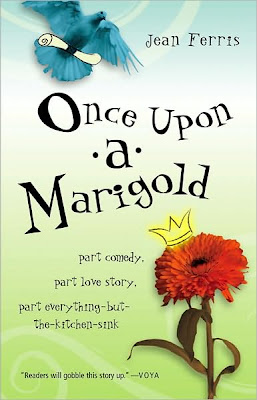
Jean Ferris is probably best known for Once Upon a Marigold and its sequel Twice Upon a Marigold, her updated fairy tales about a mind-reading princess, a runaway boy and the dwarf who cares for him, an evil queen, and the tooth fairy. However, Ms. Ferris has been around for quite a while and is deserving of a wider audience. Her fiction is wonderful for young adults and upper elementary kids -- full of humor and emotion and exiting action.

What I love most about Jean Ferris is her selection of quirky, screwball comedies. The two Marigolds fall into this category, as do Love Among the Walnuts and Much Ado About Grubstake. There's a quality to them that makes me think of John Irving (The World According to Garp); they are full of characters that in other novels would be hopeless misfits and yet in Ferris's stories they are valued individuals and important to the resolution of the story.

It's practically impossible to describe the plot of Love Among the Walnuts, other than to say that it involves a mental institution, a pair of evil uncles, and two people and a chicken who've been put in a coma. In Much Ado About Grubstake, 16 year old Arley has to outsmart a powerful businessman who is trying to buy up all the played-out mines in tiny, run-down Grubstake. That she has to manage this with a misfit collection of townspeople and reformed bad guys is part of the novel's charm.

Her comedies always bring together strange assortments of people with all their quirks and oddities and over the course of the story they manage to find family in each other. I love that about her work.


All of her comedies are suitable for younger readers -- say 3rd grade and up -- but would also work for older readers right through high school. They are great vocabulary stretchers, too, so much so that I had my 9 year old start making lists of words she wasn't sure about. She's probably added 50 new words to her vocabulary thanks to Jean Ferris.

Ferris also has some more serious novels and these would be more appropriate for a little older audience. Of Sound Mind is a fascinating book about a boy who is hearing but has been raised by deaf parents. Theo's role as family interpreter is explored even as it changes when his father has a stroke and his self-absorbed mother can't bear to take care of him. Once again, Ferris does a nice job of portraying people with all their warts, though this time with a more serious bent.

Into the Wind is part one of a three-part series which is more or less a romance for high schoolers, complete with an orphaned heroine and a dashing pirate who rescues her. It takes place in 1814, is loaded with action, and provides some historical detail, all in a wholesome, totally-appropriate-for-older-teens story (no bodice ripping here, folks).

Underground is another historical novel, this time exploring slavery. The main character, Charlotte, is a slave at the Mammoth Cave Hotel. When she discovers runaway slave sometimes come to the hotel on their way north, Charlotte has to decide whether she, too, will run away or stay with Stephen, another slave who doesn't feel the need or desire to leave. Another one which would be good for junior high and up.

Ferris does a wonderful job of creating memorable, original characters in compelling, entertaining stories. It's definitely work looking her up the next time you need reading material for your older kids.


Monday, November 1, 2010

The Lost Hero


Okay, I know I'm a little late to the party. This book came out about a month ago and I am only just now getting around to writing about it.

But wow, what a book!

If you liked the Percy Jackson and the Olympians series, this one picks up just a few months after The Last Olympian left off, with a trio of demigods visiting the Grand Canyon. Jason wakes up on a bus, completely unsure who he is. On one side of him is Leo, his best buddy. On the other is Piper, his girlfriend. All good -- if he could just remember them.

Eventually the three are "extracted" from their field trip and brought to Camp Half Blood, where the mystery around Jason deepens further: Chiron tells him he's supposed to be dead. In Cabin One, where the children of Zeus are housed, Jason sees a picture of Thalia and realizes that she's his sister. But how is this possible? Chiron knows but is sworn not to talk about it. No less mysterious is Jason's ability to speak Latin and the odd tattoo on his arm. Who is this guy?

Add to this the fact that Zeus has closed Olympus -- no communication in, no communication out -- and Hera appears to have been kidnapped. Jason, Leo and Piper are sent on a quest to rescue the queen of heaven and hopefully prevent the rising of someone or something that will make Kronos look like a Sunday School Picnic. A nice touch is that the story is told from three viewpoints: Jason's, Leo's and Pipers. It's a good move away from the Percy Jackson series that makes this one feel more like it's a new series, albeit with many familiar characters.

Like all Riordan's books, this one's a thrill ride. Action comes thick and fast and it's a compelling read, not least because of the tantalizing clues to the mystery surrounding Jason. This one is targeted for older kids -- the heroes are 15 and act it. There are a few OMGs, but it's otherwise clean. Violence is, as before, somewhat softened by monsters turning to dust when struck. Themes are a little more serious; the infidelities the gods indulge in are touched on with a little more directness and the consequences of those infidelities are played out in people's lives to negative effect. This one might be best for 7th or 8th grade and up.

The Lost Hero is what I like best about kid lit. It's pure entertainment, well written and leaves you dying to find out more. I can't wait for the sequel, due out in the Fall of 2011, and am hoping it's just the beginning of a nice long series.

Friday, October 15, 2010

Not for the Faint of Heart


Or the clinically depressed. Or anyone under the age of 13, though even that may be a bit young.

Finally the library came through with my hold -- Mockingjay was mine for 2 weeks. Naturally, I put the laundry on hold, quit feeding the kids, gave my husband the cold shoulder, and read it cover to cover.

It's good. Very good. But it's dark. Very dark. I could give you a dozen spoilers, but I think the best thing to say about it is that it very accurately portrays the effects and after-effects of war -- even a necessary war such as Katniss is fighting. It does a fabulous job of showing how both sides manipulate people and information for their own ends. And a good, if depressing, job of showing the mental unraveling of those who make it through.

There's no storybook ending. There is survival, but those who manage this do so in profoundly damaged states -- both emotionally and physically. It's well done, but it pulls no punches. You're not going to read this book and come out of it feeling light and buoyant. Be aware that this one deals with themes of murder, torture, suicide, loss, abandonment and betrayal. You will come out of it sobered by the stark, unflinching portrait of war.

Because of its mature nature, I think this one should be for 13 and up, absolutely no younger. And I really have reservations about 13 year olds reading this, so in my house, everyone who wants to read it has to be in high school.

But don't miss it -- it's a brilliant, moving read.

Wednesday, September 29, 2010

I've Got a Crush...


On Jon Berkeley.

I have blogged before about his very excellent book The Hidden Boy, so I was tickled pink to find the first book in his Wednesday Tales series, The Palace of Laughter. And I am here to tell you, it did not disappoint.

It's fantasy, but it's so fresh, and told in such a novel way...I am almost at a loss for words (and that never happens. Seriously.)
Miles Wednesday, who lives in a barrel outside the town of Larde, meets a tiger one day in the woods. A talking tiger. Who decides not to eat him. The next morning, the tiger is gone and Miles, who has run away from the orphanage (Pinchbucket House -- how's that for a name?) sneaks into the circus to see if the tiger is real or not.

Instead of a tiger, he meets an angel. A real angel named Little who's in trouble. He rescues her from the evil ringmaster, the Great Cortado, and this begins their cross country adventure. They are searching for the Palace of Laughter -- though they don't know what or where it is. They hope to find Little's angel companion, Stormpoint, but they are sidetracked by a number of odd and sometimes frankly bizarre happenings.

Love Love Love Jon Berkeley. Love his originality, love the mesmerizing rhythm of his prose. I get lost in his finely drawn, almost-modern-yet-curiously-old-fashioned-worlds. I can picture each one of his oddball characters -- from Little, whose skin glows faintly, to fat Lady Partridge, who lives in a tree house with a hundred cats, to Tangerine, the bear Miles has had since he was left at the orphanage and who is brought to life by some magic of Little's.

Seriously, give this one a try. Or read The Hidden Boy -- if you like fantasy or even just oddball fiction, Jon Berkeley won't let you down.

Monday, September 20, 2010

I Regret to Inform You...


I failed.

It doesn't happen often, this type of failure. But occasionally there's a book I just. can. not. get. into.

Linger was that book.

I tried, I really did. But I just couldn't bring myself to care what happened to Sam and Grace and all the werewolves. You can read my thoughts on Shiver, the first volume of the series here. I still have some objections because of the premarital sex. Other than that, Maggie Stiefvater is a fine writer, but the whole thing just left me saying "meh."

Apparently in this volume, Grace turns into a wolf and that's the big cliffhanger.

Meh.

At least they'll get a trilogy out of it. Whoo hoo.

Monday, September 6, 2010

I am a Genius of Unspeakable Evil and I Want to be your Class President


I am a sucker for a good title, and this one caught my eye at Barnes and Noble (who don't pay me to mention them at all. Although they should. 'Cuz I shop there. A lot. And I wouldn't say no to some free books. Or whatever.). I tracked it down at the public library and was more than rewarded for my effort. This is one of the funniest books I've ever read. Ever.

I am a long-time fan of The Daily Show -- it's one of the few things I regret about not having cable. And this book, written by Josh Lieb, an executive producer for The Daily Show, has all the earmarks of a great Daily Show episode. The humor is edgy, it pokes fun at everyone and everything, and it is merciless. Really, the whole book felt like it was channeling Jon Stewart, only through 12 year olds.

Seventh grader Oliver Watson, the dumbest kid in school, is actually a genius masterminding a worldwide empire, both legitimate and criminal, from a bunker he excavated below his family's home while they were on a trip to Hawaii. From there he orchestrates kidnappings, the overthrow of a corrupt African dictator, the love life of his English teacher, and the eighth grade student council elections. Or at least, that's what's supposed to happen. But life in 7th grade doesn't always work out quite the way one hopes.

I am a Genius may remind some people of Artemis Fowl, but without the distraction of fairies and leprechauns. However, unlike Artemis, Oliver is not a nice person. Really, really not a nice person. But he is a funny person. And being inside his head, once you recover from the initial shock, is funny, too. Much of the book is pure fantasy -- what wouldn't we have given to have a tool that could give our teachers a little electric shock every time they zinged us verbally in class? Or blow darts that our private bodyguards shoot at kids who pick on us -- darts that make those bullies suddenly flatulent in front of the whole school?

Here's my problem with this book: it's billed as a book for 12-14 year olds. That's because Oliver is 12. By this reasoning, we should be letting 8 year olds watch The Exorcist. That's a movie about an 8 year old, right? That should be okay for kids, right?

I so wanted to put a picture from The Exorcist here, but I just can't. That movie still scares the CRAP out of me.

The themes this book deals with, the satire, the relentless skewering of every junior high stereotype, is going to go right over the heads of kids who are actually in junior high. This book is deeply disrespectful of teachers, parents, basically anyone in authority. This is fine if your audience can grasp that it's satire. Otherwise, Oliver and his evil plans are just mean. There are cultural references that many kids aren't going to get, and there's a lot of crude language and mild swearing that seems not very appropriate for this age. I do think this would be fine for high school students and I highly recommend it for adults who have lived through the hell-on-earth that is junior high. It will make you laugh. A lot.

Potential distractions: Oliver likes to footnote himself quite a bit, and going back and forth from the story to the footnotes might be disruptive for less able readers. Also, Oliver writes like an adult (he's a genius, remember) so the vocabulary may be a little above some kids.

Seriously funny, but seriously not for junior high aged kids. Save this one for the 9th grade and up crowd.

Saturday, June 19, 2010

The Red Pyramid OR Percy Jackson Goes to Egypt

The Red Pyramid is Rick Riordan's newest novel for the pre-teen and teen set. In it, Carter and Sadie Kane find out they are members of an ancient family of magicians, entangled for millenia with the Egyptian gods. If this sounds a little reminiscent of the Percy Jackson and Olympians series, that's because it is.

Some things are quite different: there's the obvious difference between the Egyptian and Olympian gods, the heroes are a brother and sister, there's a society for magicians which is distinctly unwelcoming to the pair, and there's a persistent theme of possession -- gods possessing humans to achieve their own ends, or humans "hosting" gods to achieve their own ends.

But the action -- fast and well done -- is the same, as is the light, humorous storytelling and the need for the characters to find out about/explain the Egyptian myths. Likewise, there's a long-imprisoned monster who is longing to break free into the mortal world again, thus bringing about the destruction of life as we know it.

There are enough differences to make the book mostly feel like a separate adventure; the narrative bounces back and forth between Carter and Sadie, which allows the reader to see more sides to the story; but there are many places that felt similar to the Percy Jackson books. There are many more OMGs in this book, but no other swearing, and the violence is again mitigated by the monsters turning to dust when they're killed. I was uncomfortable with the possession theme and with the minions, who are occasionally referred to as demons, so would probably not let a child under 10 read this one, and possibly not a child under 12 without some discussion about how contrary to our beliefs this book runs.

It was a good, fast-paced read and very enjoyable, so here's my verdict: if your child read the Percy Jackson books and loved them, this will give them a hit of what they liked. If, like me, you're uncomfortable with some of the themes, you might want to hold off on it until your child is older or give it a miss entirely.

Wednesday, June 16, 2010

Runaway


"What happened to that book you were reading about
China?"
"Lost on Planet China? I finished it. Now I'm reading
a book about a girl who had a brain transplant against her will."
"What?"
"A brain transplant."
"You're kidding me, right?"
"Um...no."
"Who in their right mind would buy a plot about a brain
transplant?"
Yep, it's book three in Meg Cabot's Airhead trilogy. Runaway follows the further adventures of Emerson Watts, whose brain was transplanted into the body of supermodel Nikki Howard after a freak accident at a Stark Megastores' grand opening. Book one, Airhead, is mostly concerned with Em learning to live as Nikki. In book two, Being Nikki, Em learns that Nikki didn't die of an aneurysm as she'd been told, but is very much alive and the victim of attempted murder because of something she'd overheard about Stark Megastores and the launch of their new, low-cost laptops. She tried to blackmail her boss and wound up as nothing more than a brain to be discarded until a compassionate doctor transplanted her into yet another available body, this one much too average for Nikki's taste.

Book three opens with Nikki, her mother and brother, and Em all being held prisoner by Brandon Stark, Nikki's one-time boyfriend. He wants Nikki's secret so he can blackmail his father. Nikki wants her old body back. Lulu, Em's roommate, wants Nikki's brother, Steven. And Em? She wants Christopher, her best friend, to be more than a best friend.

Got that?

It's barely plausible as a plot, but it is very readable and funny in a campy, conspiracy-theory kind of way. I like Meg Cabot's writing style -- she's like a Sophie Kinsella for the high school set -- but she doesn't quite make it past my mom-filter on this one. My biggest objection throughout this whole series has been the implication that Nikki is no sexual innocent. Em is, there's no question of that, but many references are made to Nikki's body and its sexuality. Em is confused by the sensations and signals her new body sends her. In book three, we find out that Nikki really isn't an innocent -- Brandon admits he'd only stayed with Nikki "for sex." And Nikki's been a bit of a skank, sneaking around behind Brandon's back to hook up with Lulu's boyfriend at the time, Justin. But now she wants to get back together with Brandon because she's convinced he'll be able to help her get a reverse-brain transplant so she can go back to being Nikki, even though the operation would almost certainly kill either her or Em or both.

Got that?

Em has to deal with the fallout from their infidelity, has to make sense of her body's messages, has to find a way to get Christopher to see that she loves him (though I have to say, this is pretty obvious and I found myself wondering how she could miss something so glaringly clear). While I like Cabot's easy, breezy style, and I very much liked the realization Em has that being pretty on the outside doesn't really make up for being a jerk on the inside, I have all the same objections I had to the first book; there's just too much sexuality in this for me to be comfortable with it as a junior high book, and almost too much for me to be comfortable with it below age 16.

Saturday, May 29, 2010

The Silver Spoon For Children

Bookivore is always looking for ways to help her children enjoy foods that are real; i.e. not shaped into a nugget first and then fried into oblivion. The children, naturally, resist. But this book, this book just might give them the nudge they need to start seeing food as, well food, rather than spending whole meals accusing me of trying to kill them with vegetables.

The Silver Spoon for Children is delightful. It's loaded with luscious recipes and even more loaded with cooking technique -- how to chop, dice, slice, whip....it even gives a little background on Italian cooking.

While the dishes are photographed, the instructions are all meticulously illustrated. They made me think of the kind of field guides you'd find in a nature book. They're child-friendly without being patronizing. You feel like you're reading a 'real' cookbook, and you are.


The recipes cover a range of things, from classics like spaghetti and tomato sauce to risotto and caprese salad (which I noticed was light on the basil -- definitely something that would have a high ick-factor for my kids). But it also covers snacks , lunches, and, most importantly, desserts. I liked that it wasn't gimmicky -- no cartoon characters, no celebrities, just yummy food.

I can't vouch for the recipes, whether they work or taste great, but they look yummy and I am itching to try them. This strikes me as a great gift for a child who's just old enough to truly help out in the kitchen and is eager to make stuff herself (or himself, for that matter). It might also be fun as a summer project, teaching your child or children to make a few things that fall within their ability level.


The cover price is $19.95, but Amazon has it for $13.39 online and it would be worth checking with your public library -- they often have awesome collections of cookbooks. And what the heck, it might even get them to try something new.


Saturday, May 15, 2010

The Hunger Games Series


Quite often I read two books at the same time; one I keep upstairs for reading at bedtime or while I'm blow drying my hair (I hold the book open with my toes and dry my hair more or less upside down) and the other I keep downstairs for reading during the odd moments that I'm not doing something else. This only works, however, if the two books are about equally interesting. When I started Suzanne Collins' The Hunger Games, it was my downstairs book. But then it started migrating upstairs with me, and then I just had to stop everything and finish it because it was just. that. good.

Collins is a veteran writer and I greatly enjoyed her Gregor the Overlander books, so I expected this one to be good. I did not expect to be carried away by it to the point that I almost couldn't bear to make dinner because I was frantic to find out what happened next.


Katniss Everdeen lives in a post-apocalyptic North America in which the the country has been divided into 13 districts, all subjugated by The Capitol. Except for District 13, which has been obliterated by the Capitol in reprisal for their rebellion. As part of their subjugation, each district must send tributes -- a boy and girl between the ages of 12 and 17 -- to participate in the Hunger Games each year. Games in which the tributes must fight to the death. By this means does the Capitol exercise its power over the districts. This year, Katniss's 12 year old sister, Prim, is chosen. Unhesitatingly, Katniss volunteers to take her place.

The rest is a roller coaster ride of strategy, stylists, ambushes, alliances and lots and lots of death. I'm not going to explain the details, only say that once Katniss enters the arena, I defy you to put this book down until you've seen it through to the end. There are classical echos here: it brings to mind the Athenian tributes sent to face the Minotaur, and the gladiators who fought each other in ancient Rome. Many of the characters have Latin names, so the parallel isn't accidental. The entire society of the Capitol is a bizarre blend of frivolity and violence -- one minute people are dying their hair purple and tattooing themselves, the next they're screaming for blood during the games.

The second book, Catching Fire, which deals with uprisings throughout the districts, is even more absorbing than the first, which makes it breathtakingly good. Unfortunately, I now have to wait until August -- AUGUST! -- for the third book, Mockingjay, to come out. I'm not sure I can make it that long.

They are violent books -- the premise is such that they can hardly be anything else -- but there's real poignancy and pathos in most of the deaths. And beyond the violence, the books are thought-provoking in a timely way. The terrible waste of life and the terrible cruelty of the Capitol serve as backdrop for Katniss's coming of age, in which she is forced to weigh issues many people never face. At what point does life become so terrible that rebellion is preferable to living? These are for Junior High and up, because of their violent nature, but don't let the violence cause you to pass these by. They are truly, among the best books I've ever had the good fortune to read.


Sunday, April 25, 2010

Magazines for Kids

Access to books is a critical aspect of cultural capital. But equally important is exposure to a range of texts and formats -- it allows children to transfer the skills they learn reading fiction to other mediums, and adapt them to works of different format and lengths.

Magazines are a great way to give kids experience with different kinds of texts -- poems, non-fiction articles, short stories, song lyrics.


Back in the stone age, when Bookivore was a kid, there was one magazine for kids: Highlights. That was it, folks. Now there is a veritable feast of magazines for children, some quite excellent, some just thinly-veiled advertisements for products, TV shows and movies. Highlights is still a favorite at our house: it's far more colorful than what it was when I was a kid, and nicely multicultural too, teaching about Diwali, Ramadan, Chinese New Year and a host of other cultural celebrations and traditions. The magazine works hard at promoting good values and good behavior, which it does this from a sense of fair play rather than from any particular belief system. It's a nice blend of fiction, non-fiction, poetry, comic strips and puzzles that appeals to kids from 3 to 10.


A nice addition to the Highlights stable is High Five, their magazine for 2-5 year olds. The text is much simpler, pictures are larger and fill the pages. It has the same focus on good morals, though the message is obviously greatly simplified. One lovely feature of both these magazines is no advertising.


I absolutely love these next three, put out by the National Wildlife Federation: Ranger Rick (at the top of this post) Your Big Backyard, and Wild Animal Baby.


Like the two Highlights magazines, the NWF's offerings are stepped for different age groups. Ranger Rick is for ages 7 and up, though for independent reading your child might need to be a little older. Your Big Backyard is for 3-7 year olds, and Wild Animal Baby is for 1-4 year olds.


One nice feature about Wild Animal Baby is that it comes in a board book format of heavier cardboard, rather than flimsy magazine pages. It's perfect for little hands to hold. The photography in all these magazines is fantastic and the range of articles is impressive -- whatever animals your little ones like, they'll show up eventually in these pages, one way or another. Another blessing: no ads to disrupt your reading.

National Geographic Kids is another one we get, but I would be lying if I said it was a favorite. It was a gift, otherwise I'd cancel my subscription. I find the layout overly busy and it's loaded with ads for candy and video games. Additionally, it contains feature articles on movies -- special effects, actor interviews, etc. Not strictly National Geographic stuff -- more along the lines of paid endorsements. In and among the plugs are some interesting articles about animal rescues, critter cams, and habitats, but it's pretty buried in junk. Ostensibly for 6-14 year olds, but I can't see kids sticking with it that long.


Another one for 2-6 year olds that gets good reviews is Ladybug. It's colorful and full of stories, poems. The publishers also have a magazine called Babybug, which is made of heavy stock like Wild Animal Baby. They also publish one called Click! which is geared more towards science and nature.


Of a similar nature is Spider, which is for 6-9 year olds. It includes stories, poems, articles and illustrations from around the world.

For older kids, there are magazines about science, like Odyssey.


And magazines about world history, like Calliope.


If you have a sports nut, Sports Illustrated for Kids might be a good choice. Parents rated this one very highly because it focuses on the positive achievements of athletes and their good sportsmanship, rather than on their questionable activities and sexual antics. One word of caution here would be that kids may assume the adult version of SI is okay because of their exposure to SIKids. Obviously the articles in SI are going to burst some bubbles, so that's something to consider.

Appleseeds is a magazine full of non-fiction and social studies articles for kids ages 7-9. Each issue covers a particular theme: Becoming President, Whiz Kids, Unusual Structures, Halloween. Rather a narrow age range, but the content makes it of use in giving kids experience with non-fiction text.


Ask is for 7-10 year olds covering science, inventions, recipes, web activities, projects, and other activities. Each issue is devoted to a particular theme -- water, camouflage, migration, the musical brain, etc.

Cricket has been around since the '70s and is another publication that celebrates fiction, though this time from established, even classical writers like Shakespeare, Robert Frost, Shel Silverstein, and Lloyd Alexander. It also includes games and puzzles. It's geared for 9-14 year olds.


This is really just a sampling. There are many more publications for kids, of varying quality: American Girl Magazine, Kids Discover, Boy's Life, Cobblestone, Girl's Life, Disney Princess, Dig, Nick Jr. Preschool Playroom. The list goes on and on.


Before subscribing, go to your library and see what these magazines offer -- look at several issues, if possible, to get a sense of the kind of content they regularly offer. Be leery of magazine that contain a lot of ads: they really will encourage your kids to pester you for Yogos, or whatever. And if the subscription prices seem too high, remember that magazine subscriptions make excellent birthday and Christmas gifts from Grandma and Grandpa. All of our subscriptions have been gifts and they are very much appreciated.


Images courtesy of Amazon.com and National Wildlife Federation

Thursday, April 22, 2010

Mexican Whiteboy


This one took some getting into. It's a rough read -- the author, Matt De La Pena, more or less drops you into Danny Lopez' world without a lot of background. And Danny is a kid caught between two cultures, neither one of which feels precisely like home. Hence the title.

But it could have been called Mexican Blackboy just as easily, because the story passes back and forth between Danny, who is half white, half Mexican, and Uno, who is half Mexican, half black. Both long for their fathers: Uno to live with his, away from his abusive stepfather, and Danny just to find his, who's gone off the radar, possibly to Mexico.

I chose this one to review, not because it's new -- it's from 2008 -- but because it recently showed up on a list of books for reluctant readers and boys, which are sometimes the same thing. It has a lot of baseball stuff in it; Danny is a pitcher with a golden arm but he can't control his delivery in clutch situations. He is socially awkward, never feeling like he belongs. He is too dark, too Mexican for his San Diego prep school, and among his Mexican relatives in National City, he is too light. Also, he speaks no Spanish; he is completely left out of about 50% of their conversations. Still, he chooses to spend the summer with his Mexican family.

The language in this book is very coarse, but authentic. Having grown up in the Southwest and having attended a high school that was about 15% Hispanic, the characters' voices are true-to-life as I remember them, and having taught high school for 10 years, I can vouch for the swearing -- there's a lot of it, just as you'd hear in most high school corridors. There's also drinking, pot smoking, and drug dealing (talked about, not actually done). And there's poverty. Most of the people in National City are poor. And many of them are hopeless in their poverty.

The language was hard to get over, but there is much in this story to recommend it. I found myself really bleeding for Danny, who wants so much to know his dad and can't figure out what he did to make him leave. One possibility, he thinks, is that he's just not Mexican enough for his dad. His distress runs very deep. He has more or less quit talking, fading into the background. But at the same time, he's developed a habit of digging his fingernails into his forearm to remind himself he's human. He's done it so often, his arm is scarred. And he writes long, imaginary letters to his dad in his head; letters in which he tells his dad how successful he is, how popular. None of it is true: it's his deep, deep longing for his father to want him, to approve of him. His emptiness, his fractured spirit, got to me. I wanted to deck his stupid mom, gushing on and on about her new (white) boyfriend, the successful San Francisco businessman, while totally ignoring her son's pain, his utter lostness. Her selfishness was hard to take.

There's a subplot with a girl named Liberty, another "halfie" who speaks no English. It's part of Danny's oeuvre that he longs for her and yet can't communicate with her at all, both because he can't speak Spanish and because he can barely speak around people anyway. Danny does resolve some of his issues, both with Liberty and his dad (who (SPOILER ALERT) he discovers is actually in prison). It puts a different complexion on things to know his dad isn't staying away because he doesn't love him. However, before he figures out where his dad is, there's a scene of breathtaking violence in which Danny witnesses his uncle run a man down and then beat him senseless, and then run over him again, breaking his legs. It's meant to give Danny (and the reader) a glimpse into the psyche that landed his dad in jail, although Danny doesn't understand it that way yet -- he only knows that this violence somehow reminds him of his dad. Danny is so horrified, he vomits, and frankly, I got a little queasy myself. It's a powerful, visceral scene, not for the faint of heart.

I'm on the fence with this one. On the one hand, it's authentic, it's compelling, it's got real emotional depth and is an insightful portrait of what abandonment, divorce, and parental selfishness do to kids. On the other hand, it's authentic in the roughest possible way, and that isn't a pretty thing. So I'm going to be a weenie and not come down on either side of this one, except to say that it's a high school book ONLY -- no lower. And an upper high school book at that. It's rough, but it has its merits. Just be aware of what your child might be in for if this one pops up on a booklist and consider well whether your child has the maturity to deal with it.

Monday, March 8, 2010

Fire


Fire, labeled as a companion to Graceling, by Kristin Cashore, is every bit as strong as Cashore's debut novel, and a darn good read. Unfortunately, it is once again targeted to an audience for whom some of its subject matter is just not going to be appropriate.

Fire is a monster, which in the fictional kingdom of the Dells means she possesses unnatural coloring (her hair is flaming red -- poppy, vermillion, fuschia), unnatural beauty, and the unnatural power to control others with her mind. The Dells are home to many kinds of monsters -- royal blue leopards, chartreuse birds of prey, lavender mice -- all of whom have this power to control with the mind, though in varying degrees. Oddly enough, the food they crave the most is other monsters, so Fire is constantly in danger of being monster lunch.

Human monsters are rare and their lives are deeply complicated. Either loathed for their abilities or over-loved for their eerie beauty, they are perpetually in danger. The book is very clear that one danger Fire faces wherever she goes is rape -- some men simply can't control themselves around a monster woman.

Fire is caught up in the royal family's attempt to thwart an overthrow of the kingdom by a pair of rebel lords. The reason the kingdom is in such a sorry, vulnerable state is because Fire's father, also a monster, helped run it into the ground with the previous king. Fire is trying as hard as she can to be different from her pleasure-loving, thoughlessly cruel father. And she is, but many assume the apple doesn't fall far from the tree. There is a second plot involving a character from Graceling where Fire becomes the target of a monster-collector.

This book is listed as "grade 9 and up" but to me, that's far too young. Right from the beginning, it's made clear that Fire, who is 17, has a lover. The book does not describe their encounters explicitly at all, but their relationship is casual and Fire has no desire to make it permanent by marrying Archer. Archer, her childhood friend and lover, is not faithful to Fire. He has a number of casual rolls in the hay, two of which result in pregnancies. Cansrel, Fire's father, is portrayed as extremely cruel. He almost certainly kills a dog of Fire's that nips her accidentally. Likewise the book tells us he has compelled women to sleep with him, then killed the women who became pregnant, not wishing to share his world with any monster children, even his own. He is a drug addict and a sadist and he feels that his mind power entitles him to control others. The former king punishes one of his lords by having his wife raped. He punishes his Queen's lover by having his legs crushed. Many people get killed in this book, mostly minor characters, but one or two major ones. And their deaths have emotional repercussions -- these aren't comic book deaths. In fact, Cansrel's death (and life) continue to have far-reaching consequences for Fire and the royal family.

If you read my earlier review of Graceling, you'll know I like Kristin Cashore's books. I just can't figure out why publishers think these books are for kids 14 and up. Infidelity, rape, casual sex, sadistic cruelty, murder...I don't know. It just doesn't scream "Kid Book" to me. I enjoyed this book -- in fact, I could hardly put it down -- but it's a book for adults.

Sunday, February 28, 2010

Background Reading

A super quickie: If you have a child who is interested in the Percy Jackson series by Rick Riordan, this little book from Dorling Kindersley (DK) is good background reading. It covers the basic relationships between the Greek gods and also many of the hero myths -- Hercules, Perseus, and Theseus -- and some of the more familiar stories like Pandora, Midas, Orpheus and Daedalus. It's a nice overview that helps put the Percy Jackson books in context and makes some of the monsters and events make more sense.

Note: this is the same book with different covers. Your bookstore might have either one.


Wednesday, February 17, 2010

Shiver


Shiver, by Maggie Stiefvater, is going to remind you of Twilight. The comparisons between the two are inescapable: the whole star-crossed, girl-meets-supernatural-boy thing is just too similar. But where Twilight shows a certain restraint, Shiver's characters don't remain as chaste.

Grace was attacked by wolves as a little girl -- pulled from her tire swing and dragged into the woods, she should have died. Somehow she didn't, and now she has an obsessive interest in wolves...in one particular wolf with yellow eyes.

After a classmate is killed by wolves, hunters enter the woods to exterminate the pack. Grace, terrified that something might happen to "her" wolf, manages to stop the hunt, but not before one of the wolves is shot. Arriving home, she discovers a boy on her deck, covered in blood and obviously suffering from a gunshot wound. He has yellow eyes. Somehow she knows that he is her wolf.

It is love at first sight, or at least at first human sight since all their prior contact has been inter-species. Sam moves in with Grace (her parents aren't very parental: they spend all their time acting like they don't have a child and don't notice that Sam is staying in their home, despite the fact that he lives there for more than a month).

Cold, it turns out, is what changes the werewolves into wolves. The colder the weather, the closer they get to changing until at last they change for the winter and don't become human again until spring. And eventually, they don't change back at all, living out the rest of their lives as wolves. It becomes critical for Sam to stay warm: he is close to changing and is certain that this will be his last year -- after he changes this time, he will not be human again.

The central mystery of the book is whether there's a cure for this ailment. Grace was bitten during her attack as a child, yet has never changed. She appears to have increased sensory awareness -- her wolf sense -- but she stays Grace. How is this possible? What implications are there for Sam?

Some of the writing is lyrical. It draws heavily on poetry -- Sam is a songwriter and the loss of his self-awareness when he becomes a wolf is devastating to him. He is forced by his nature as a werewolf to live in the moment. Grace, on the other hand, is hyper-responsible, a planner, and her practicality in the face of her parents' immaturity is another theme that's well handled. Their different approaches to this problem of Sam's wolfishness are part of what makes the book work.

Where Twilight spends three full books on the "I want you-But we mustn't!" tug of war, Shiver only draws out the suspense for about 2/3rds of the novel before Sam and Grace sleep together. I have a problem with that, given that this is targeted at 13-18 year olds. Granted, they are supposed to be soul-mates (wolves, you may remember, mate for life), and it's not explicit, but still, Grace is only 16 or 17. Shiver's language is also rougher; more OMGs, a "bitch" or two, and one reference to "ass-kicking boots." It's relatively tame compared to the way actual high school students talk, and not at all gratuitous, but it's there.

The ending really got me, mainly because it wasn't well explained. I found myself closing the book and thinking, "How did that happen?" I think I have made peace with it in my head, but to say that it's clear would be grossly misleading. Perhaps this is going to be explained in the sequel Linger, due out this summer (2010).

Shiver has some nice bits -- the poetry, Sam's agony as he anticipates losing himself and Grace, perhaps forever, the way weather intrudes in and shapes the story. But I wouldn't recommend it for kids under 16, because of the sexual relationship.

And seriously consider reading this one under a blanket, because the constant references to the cold start to get to you after a while.

Monday, February 8, 2010

Invisible Detective

The Invisible Detective, by Justin Richards, is a series billed for 5th to 8th graders with mystery and adventure and a dose of the paranormal thrown in for good measure.


It's not new -- book 1, The Paranormal Puppet Show (which goes by Double Life in the U.S.) was published in the UK in 2003 -- but it hasn't been heavily promoted in the U.S. and that's a shame because these are really excellent books.

The stories center around a group of children in 1936 London; Meg whose father knocks her and her mother around, Flinch, who has no family and lives on the street, Jonny, who is undersized and bullied, and Arthur Drake, the 14 year old son of a Scotland Yard detective. Together they have become the Cannoniers, the leg-men for a mysterious character known as the Invisible Detective. The book reveals right away that there is no Invisible Detective -- it's Art and his friends, solving minor mysteries and answering questions for the people of the community. Suddenly, though, they find themselves caught up in a real mystery, and one that threatens to be much bigger than they bargained for.


An odd exhibition has come to Cannon Street -- a warehouse filled with automatons which look eerily like people who have been reported missing in the community. Coincidence? The children aren't sure, but there is certainly something sinister going on, if only they could figure out what it is.


At the same time, there's a parallel story from 2003; Another Arthur Drake, this one thoroughly modern, stumbles into a shop one day and discovers the casebook of the Invisible Detective. Funny thing is, the whole notebook is in Art's handwriting. He becomes obsessed with figuring out who the Invisible Detective was, and how he himself seems to "remember" things he wasn't even alive to experience.


The story is full of action, creepy, but pleasantly so, and the characters are likeable. The historical period is one which American kids aren't going to be familiar with -- it concerns the abdication of Edward VIII so he could marry Wallis Simpson, and Hitler re-arming Germany prior to the start of WWII -- but the events are pretty well explained for readers.


I think this one could be for kids even older than 8th grade, certainly at least through 9th grade, and possibly even through 11th. I wouldn't go much younger than 5th grade, as it might be a little scary, a little violent (people do get killed, though all the violence is at the end and is not graphic at all) for younger kids and the complexity of the language is better for middle school and older.

This is a series that deserves a wider audience in the U.S. It's good literature for kids, thoughtful, exciting, full of kids with integrity trying to do good things, a solid mystery, and a second, even more tantalizing mystery about Art himself. There are 8 books in the series -- go check them out from your public library.

Tuesday, November 17, 2009

Graceling


Some debut novels feel like a first effort; they stretch their wings a bit, wobble a tad until they find their groove. But some debut novels burst out with such a sure hand that you are instantly swept into the story and only handed back your consciousness when you've finished the ride. This is one of those books -- a great book. Once I started it, I could. not. put. it. down.

Katsa is a graceling, a person with eyes of two different colors, denoting some special skill or "grace" that is an integral part of her nature. All gracelings become the property of their kings, sent home only if their grace serves no useful purpose. What a person's grace is is not always immediately clear, but after a frightening incident when she was 8, Katsa's grace seems to be killing. Naturally, she is now of great use to her uncle, the king.

She is trained and she is dispatched to and fro across the kingdom, enforcing her uncle's edicts, underscoring his displeasure, punishing his enemies -- or perhaps just those who annoy him. This is her life. And graced as she is with the ability to bring death, she seems powerless to change her situation.

Enter Prince Po, the seventh son of the Lienid king. He, too, is a graceling, but his home is one in which gracelings are free citizens, not merely the tools of their king. Graced with fighting, his personality, his presence, is a revelation to Katsa and causes her to reinterpret her role as king's enforcer.

Their story begins with the kidnapping of the Leinid king's father. Who took him? Why? Katsa finds herself in the midst of a quest for answers and when she finds them, she realizes that the fate of all the kingdoms hangs in the balance,

This book is a compelling read -- fast, but not insanely so; full of action, but also thoughtful. Both Katsa and Po must grow into their graces, both literally and emotionally. Katsa in particular must find a way to come to terms with her grace, perhaps even reinterpret it entirely.

I was surprised to find this book listed as a children's book, recommended for ages 8th grade and up. Here's why I think this is maybe a high school book (perhaps for seniors), but probably really more for adults:

SPOILER ALERT (don't read farther if you don't want to know some critical stuff):

Because of her relationship with her uncle, which is that of master-servant, Katsa decides never to marry; she doesn't want anyone to have power over her again. She does not reconsider this position, even when she and Po fall in love. She makes clear to him that she will not be his wife, but she will be his lover. They sleep together, and while this is not described explicitly, they obviously enjoy their sexual relationship. They leave their relationship open-ended -- perhaps they will stay together forever, perhaps not. I rather think they will stay together, especially in light of the book's ending and the way in which they remain committed to each other in spite of the changes in their graces, their political situations, and their physical health. But the escape-hatch mentality is central to Katsa's being.

Katsa and Po are in their 20s, so it's perhaps to be expected that they aren't going to keep their relationship platonic -- precisely why I think this book is really more for adults. Their decisions about their romantic and sexual lives are those of adults, but they're being presented to kids. These are not the attitudes I want my children to develop about love and sex and marriage.

There's quite a bit of violence in the book. It's not overly gory, not even particularly visceral, but Katsa kills and tortures people for her uncle, so much of what she does is fairly unpleasant. Her own unhappiness about this underscores the gruesomeness of her job. Then, too, there's King Leck, whose sadistic love of hurting young girls is not for the faint of heart. That scenario alone makes this for older kids -- high school at least.

In spite of this, I can't stress enough how much I liked this book. I felt for Katsa, whose ability was subjugated to someone else's will. I liked Po and the way he pulled Katsa out of herself. And I loved the mystery they solved together, only to discover that the solution presented a far more deadly problem than either of them realized.

A great book, just a little mistargeted in terms of audience.

Saturday, October 31, 2009

Airhead -- Not Really for Kids


Unlike Allie Finkle's Rules for Girls: Moving Day, Airhead, by Meg Cabot, is just what she does best. It's light -- fluffy, even -- and eminently enjoyable. BUT, and this is a big BUT, it's just not appropriate for the 7th-9th grade target audience.

Airhead is vintage Cabot. Emerson Watts is a 17 year old on a scholarship in an elite New York high school. She dresses in jeans and t-shirts, is a self-described brainiac, and loves playing computer games with her best friend Christopher. She is also secretly in love with Christopher, but can't get up the nerve to do anything about it. Her parents are professors, her mother a professor of women's studies so Em and her sister have been raised to reject sexist roles. Little sister Frida, though, secretly aspires to be a cheerleader.

While chaperoning her sister at the grand opening of the new Stark Megastore in their SoHo neighborhood, Em is involved in an accident touched off by some protesters and is struck by a falling plasma TV. As the paramedics are working on her, teen supermodel Nikki Howard, also at the grand opening to promote the store, collapses with a fatal brain aneurysm.

Now, I know this next bit is going to seem like a huge stretch of the imagination, but Em's brain is removed from her irreparably damaged body and transplanted into the brain-dead supermodel's body. When I first realized that this was the premise, I thought "you have GOT to be kidding." But actually, the book is so fluffy, so not taking itself seriously, that I bought into it. Cabot does a nice job of explaining that this sort of thing has been going on for years, and that any number of celebrities and members of royal families who are presumed dead, are actually walking around in other people's bodies to avoid detection by law enforcement or ex-spouses or the paparazzi. It's the most campy conspiracy theory you've ever heard and it made me laugh.

Much of the book is concerned with Em coming to grips with her new identity. Part of the agreement her parents had to sign said that Em, who is now legally Nikki Howard, must honor all of Nikki's contracts and obligations, so Em is catapulted into a life of photo shoots and late night parties. If Em spills the beans about her true identity, her parents will immediately owe the hospital $2million for the transplant and they could all face jail time for breaching the confidentiality clause. Nikki is an emancipated minor, so Em now has freedoms, and money, she never before enjoyed. Em's life has been well-grounded up 'til now, but Nikki's has been rather less supervised. Although Nikki doesn't drink (she has acid reflux) or do drugs, she certainly has enjoyed a dating life that the much more sheltered Em now has to deal with. There's also a subplot, which foreshadows the next two books, about Stark Megastores and the possibility that they're spying on Nikki, though for what purpose is still a mystery that Em has to work out.

This is the part that gets sticky for me. When I read a book like this, I read it on two levels -- first I evaluate it for myself and then I put it through my Mom-Filter to see how I'd feel if my daughter were reading it. Airhead passes my standards easily, but fails to make it through my Mom-Filter. There are a lot of OMGs in the book...lots and lots, in fact. And Nikki's friend Lulu tells her "way to be a bitch," which I didn't much like, particularly since these girls are supposed to be the height of cool. But what really got me was the implication that while Em is an innocent, never even kissed before she became Nikki, Nikki's physical history with boys has been more involved. Her boyfriend casually assumes she'll sleep over; there's a reference to her "hooking up" with someone in Paris; and Lulu alludes to Nikki's difficulty in "stopping" whenever a boy, any boy, kisses her. Em is confused by the reactions Nikki's body has to kissing, implying still further that perhaps Nikki is far more experienced.

Frankly, I don't know how anyone thought this would be okay for 12, 13 or even 14 year olds. I might let my 15 year old read it with reservations and a lot of discussion, but no younger. The redeeming feature here is Em's innocence; whatever Nikki may have done, Em has a good head on her shoulders and has had solid parents behind her, guiding her behavior (though Em does recount her Mom's message about sex "don't have [it], but if you do, use a condom." )

Obviously the book is mostly fantasy (like Em, in her new body, discovering that Nikki's acid reflux makes chips and cookies taste bad and vegetables and tofu taste good) and good for a laugh, but it bothered me that the presumption here is that girls age 12 and up have no innocence left to shelter, so why not let this scenario with Em and the possibly very-experienced Nikki play out with all its comic consequences? I have absolutely no problem with this as an adult, or even an upper secondary book, but younger than that should be advised that the themes in this novel are far above what most middle school/jr. high kids can handle.


This is part of a series of three books. Being Nikki was released this past spring and the third installment, Runaway, is coming out in 2010.