Wednesday, May 25, 2011

Summer Lessons -- One Idea

I sat down and talked with my two oldest to get some rough structure ideas for the summer. We settled on having a library day (Mondays look good for this and help start the week out with new reading material), some pool time, some cleaning time (my idea, of course), some sustained silent reading, and some art time.

Art time?

I had to do a little searching because while Bookivore loves Art, she hates Crafts. So I was looking for something that fell more under Art and less under Cut-Paste-and-Glitter. What I found was a gem of a site that offered me projects based on actual artists (you know -- people who get paid to make art)or on artistic principles.

Woot Woot!

It's called -- appropriately --
Art Projects for Kids, and I love that all the projects have been classroom tested. Some projects need a template, which may only be available for a small fee, but most are free. FREEEEEEE!

Another nice feature is that the projects mostly require stuff you're likely to have at home or can get easily at a local craft store -- paint, oil pastels, chalk. One or two require fancy art stuff like gesso, but there's enough there that you can just skip those and find something else to do. We're going to focus mainly on drawing and painting. As a bonus, some projects upcycle old CDs and CD cases or old magazines.

To make this relevant to the books we're reading, I may adapt some of the projects to include objects or places we're reading about. Or I might just have them write about their art -- the perfect double bonus.

Summer starts in T-minus 3 days and counting!

Monday, May 16, 2011

Summer Reading Programs -- Free Books!


Where did Bookivore go? Not far, but my life was so crazy-busy this winter/spring that I was forced to take a hiatus. Sorry, peeps. I just could.not.do.it.all.


But I'm back, though maybe not as frequently, and I want to remind everyone that summer is literally right around the corner. Take advantage of these free programs to score some new books for your kids and build their reading skills into the bargain.


Half Price Books Feed Your Brain .


THIS PROGRAM HAS CHANGED: It's for kids 14 and under. Kids need to read 15 minutes a day during June and July. Parents total weekly reading numbers and initial. When kids reach 600 minutes, they can go into the store and trade their logs for a $5 coupon. Not a rewarding as in previous years, but still a worthy goal. Starts June 1, ends July 31, 2011.


Barnes and Noble Summer Reading 2011 Imagination Destination:


This program has not changed. Kids download a reading log and read 8 books. They can bring their book logs into the store and choose a free book from their list of freebies. Runs from May 24 to Sept. 6, 2011. I looked very carefully and could not find either an upper or a lower age limit, but the book choices range from 1st through 5th grade, so that may be the assumption. In the past, the expectation has been that kids will read the books themselves, so kindergarten is probably the lower limit.


Borders/Waldenbooks Summer Reading Challenge:


THIS PROGRAM HAS CHANGED. If you still have a Borders or a Waldenbooks near you, this is another option. Our store is closing because of the company's recent bankruptcy announcement, so my kids can't do this one. Kids 12 and under read 8 books, then bring completed logs into a Borders or Waldenbooks and can save 50% or more on "selected items." These are listed on the worksheet, which you can download here. May 26 - Aug. 1, 2011.


I'll be back later this week with some ideas for summer activities with kids.

Thursday, January 6, 2011

Best Books of 2010? Part Deux

Yesterday I reviewed the first half of Amazon's picks for Best Children's Books of 2010. Today we finish the list. If you like, you can look at the whole Amazon list here, and of course you can read my earlier post on the first 5 books on the list.


Brontorina, by James Howe. I like this one. Brontorina is trying something that may well not work out -- that takes some courage. The other children are portrayed as helpful and encouraging -- something all children need help being from time to time. The illustrations do a lovely job of conveying just how big Brontorina is, filling the page with her, even to the point that parts of her are off the edges and not visible to the reader. And the problem is resolved not when Brontorina changes, but when everyone around her adapts to her differences. A nice selection.
Ladybug Girl at the Beach, by David Soman: This one gets only a tepid response from me. I know some people are enchanted with this series, but it's a "meh" for me. One book about Ladybug Girl was enough, I think. A fourth book seems too much. Sorry, this one's an SMP (Shameless Marketing Plug).


Of Thee I Sing: A letter to my daughters, by Barack Obama: Well, if it's not an SMP, it's certainly an SPP (Shameless Political Plug), but for all that it's actually kind of a nice book. The illustrations are gorgeous, always a good thing, and the subject matter -- all the qualities the writer either sees in or wants for his children, exemplified by Americans of the past. Children are introduced to Georgia O'Keefe, Billie Holliday, Cesar Chavez, Helen Keller, George Washington...it's wonderfully multi-cultural, historical, even inspirational. For older kids, through 3rd grade.


Three Little Kittens, by Jerry Pinkney: Pinkney has been around quite a while, and has tackled classic fairy tales and nursery rhymes before. He's also a Caldecott Medal Winner for his 2009 The Lion and the Mouse, so anything by him packs a lot of talent and expertise. That's why I feel kind of guilty panning this one. The illustrations, normally a highlight in Pinkney's work, fell flat for me. Yes, they're lush, but they somehow looked like he was channelling Jan Brett and the fusion didn't quite work for me. And frankly, as nursery rhymes go, The Three Little Kittens is one of the more annoying ones out there, so for me this whole volume fell flat. Not an SMP, but not, for me, worth a mention on a top 10 list.

Dog Loves Books, by Louise Yates: I'm a sucker for book lovers and this one had me about 3 pages in. Dog does love books -- he loves the smell of them, the feel of them, he loves everything about them. He loves them so much, he decides to open a bookstore. This is a simple story with whimsical, soft watercolor illustrations that capture the imaginative journeys books can take us on. It will appeal to younger children, and maybe even encourage them to love books like dog does.

So there you have it: My highly opinionated take on Amazon's Best Books of 2010.

Wednesday, January 5, 2011

Best Books of 2010?

Amazon sends me these lists occasionally -- mainly because I spend enough there to support a small, third-world village -- and occasionally I find those lists helpful and interesting. More often, though, I find them to be shameless plugs for the endless spinoffs and sequels that dog the children's book industry.

Yesterday I got another one entitled Best Books of 2010. These are Amazon's editors' picks for best kids books of 2010. Again, it's a list that looks like a mixture of careful consideration and marketing strategy. There are three entries that are sequels, so only 70% of the list is new stuff, some by established authors and some by relative newcomers.


Here's my humble take on it:


Art and Max, by David Wiesener: Yes. Wiesener's artwork makes this one a good choice. He's an established author with really innovative illustrations. Love the lizards, love the focus on art, love the gorgeously illustrated story. Deserves a spot on the list.


Olivia Goes to Venice, by Ian Falconer: I loved the first Olivia book. I liked the second, I liked the third, I liked, mildly, the Christmas book, and then I got a little saturated with Olivia and have had no real desire to learn more about her exploits. There's been so much Olivia that this one doesn't really break new ground or offer anything in the way of freshness. Sorry. This one's a Shameless Marketing Plug (SMP)


The Quiet Book, by Deborah Underwood, illustrated by Renata Liwska: Yes, Yes, Yes! This is a sweet, achingly simple (in the best possible way) book that shows different kinds of quiet. From "Sleeping sister quiet," to "First look at your new hairstyle quiet," this one is beautifully complimented by Liwska's soft paintings. Excellent for toddlers and young children.


City Dog, Country Frog, by Mo Willems, illustrated by Jon Muth: Here's a pair of established writer/illustrators collaborating on a lovely story about a dog and a frog that become friends. Later, when frog is gone (read: dies) dog remembers him and befriends another. It's for younger kids and may offer a nice way to talk about emotional losses with children as they identify with the animals in the story. Deserves to be on the list.


A Bedtime for Bear (Bear and Mouse) by Bonnie Becker: This one is a sequel to Becker's A Visitor for Bear, but I think it deserves a spot on the list for two reasons. One, it's only the second book in the series and has not reached the point of over-saturation like Olivia, and Two, the chracter of Bear cracks me up. I love that he states things so firmly, so categorically, and that his firmness masks a lot of insecurity. He is pitch-perfect, as is his funny relationship with Mouse, who sees through the insecurity and helps Bear navigate his fears.

This post is so long, that I am going to review the second half of the list in my next post. Stay tuned!

Tuesday, January 4, 2011

Bookivore Takes a Breather

Where has Bookivore been?


December turned out to be wall-to-wall crazy, so I took a little hiatus during which I made cookies, attended Christmas programs, saw the Nutcracker, wrapped more presents than I could count, listened to my kids play Christmas carols on the piano, spent time with extended family, and dug my way out of this on Christmas Day:

It truly was going to be just a quick break -- like a week or so, but then I caught something that was suspiciously like pneumonia, though no one at my doctor's office called it that. Whatever it was, it flattened me for a while and that put an end to my blogging ambitions.

But, my kids went back to school yesterday and I finally have time (and healthy lungs) to take a breath and think about books again. We/they/I did a lot of reading over break and I am ready to rock -- but not until tomorrow.

See you then!

Monday, December 6, 2010

A Quick Christmas List for 2010


Bookivore and Mr. Bookivore learned early on that it was impossible (and fruitless) to compete with grandparents in the toy-giving department, so we began giving books to our nieces and nephews instead. When our own kids came along, we found there were always books we wanted to get for them, so why not save them for Christmas and dilute the river of toys a little with some quality literature? After all, every book you buy is one less toy that will break or end up at Goodwill.

So here's the breakdown for 2010:


The Lost Hero: two copies of this for our tween nephew and niece. Hardbacks of this one are reasonable through Amazon. I also saw them at Costco for about the same price.


The Strange Case of Origami Yoda: for my 11 year old nephew. Should be a hit.


Maximum Boy books: a new old series that my 7 year old recently discovered. 11 year old Max Silver accidentally becomes a superhero and has fast paced, silly adventures saving the planet. Humor that is a bit more sophisticated than Captain Underpants (but not much).


Down, Down, Down and Sisters and Brothers: We love Steve Jenkins books and these are two fairly recent ones. Informative text, beautiful collage art. These are for my 7 and 4 year olds.

Ingo: for my 13 year old niece. Loved the dark tone of this mer-people tale.

Hunger Games series: for my 16 year old nephew. He's a total omnivore when it comes to books and has been trying to get these from the library and failing. Not sure if we'll be getting him Mockingjay, but the first two for sure.

Sabotaged: for my 9 year old daughter. She began the Missing series and really likes it, so book three is going to make an appearance under our tree.


The Girl Who Could Fly: this one for my 11 and 13 year old nieces. 11 year old Piper McCloud discovers she can fly, just before she's packed off to a school for special kids called I.N.S.A.N.E. -- nothing ominous in that, right? A gem of a book.


Bobby Vs. Girls (Accidentally): for my 9 year old daughter. She is very into humorous writing now, so this one should work. Fourth-Grade Bobby Ellis-Chan is sandwiched between two sisters and has a girl as his best friend, but this is not something he wants to advertise. He gets into a series of mishaps (like finding his sister's underwear static-clinging to his shirt the day of his speech) that should have my daughter rolling.


The Case for Christ for Kids: my daughter specifically requested this one, so I think Santa is going to bring it. I haven't read it, but if it's anything like the adult volume it should be pretty good.

The Once Upon A Time series: my 12 year old niece really likes these, so we're getting her a couple to round out her gift pile. I have not personally read any of these, but my sister-in-law speaks highly of them. There are a bunch of them, retelling both classic and lesser-known fairy tales.

Here's what I'm NOT getting:

Diary of a Wimpy Kid 5: The Ugly Truth. Although both my son and his cousin want this one, I can't do it. I am not a big fan of the Wimpy Kid books -- I find the characters mean and crude and disrespectful. Sorry, no sale.

Knufflebunny Free: I loved the first two Knufflebunny books, but this one just jarred me. I realize the author is trying to show the passage of time by giving the parents in the story new hairstyles and such, but I found the change really hard to swallow. Hmmmm....maybe I'm more of a toddler than I thought.

Next week is the start of the Scholastic Warehouse Sale, so I may add a few things to my list if I hit some good deals (okay, who are we kidding -- I will almost certainly overbuy in the the book department. Don't judge me). You can check out last year's recommendations for seasonal books if you like and you can check Scholastic's website for a warehouse sale near you.


Thursday, December 2, 2010

The Strange Case of Origami Yoda

The big question: Is Origami Yoda real?

Well, of course he's real. I mean, he's a real finger puppet made out of a real piece of paper.

But I mean: Is he REAL? Does he really know things? Can he see the future? Does he use the Force?

Or is he just a hoax that fooled a whole bunch of us at McQuarrie Middle School?


So begins The Strange Case of Origami Yoda, by Tom Angleberger. And the central question, of whether Origami Yoda really knows things revolves around his "animator," the school's oddest kid, Dwight. The argument is simply that Dwight is too weird to give good advice, otherwise he wouldn't be so weird, right? And yet Tommy and his friends Kellen and Harvey begin tracking Origami Yoda's patients -- or victims -- to see whether he is the real deal or not.

This book brings up a number of middle school issues -- the kid who cries in P.E., the kids with the awful nickname, the kid dealing with an embarrassing crisis, the kid who wants to see an R-rated movie his parents have nixed, the boy who likes the girl who might not like him -- each handled by Origami Yoda. It's nicely done, all woven neatly into the mystery of Origami Yoda, which makes it more factual and less melodramatic than it might have been.


I think this one will play equally well with boys and girls, but especially with boys for a couple reasons. There's the obvious Star Wars theme, which will appeal to boys, it's loaded with doodles ala Wimpy Kid, and the main characters are all boys. Each chapter is a first person account by Tommy or one of his friends; a few are also by girls they know, but most of the story is told by boys. This would make an excellent Christmas gift for 7-12 year olds on your list, especially if they're boys.

The writing style is easier than I expected: Accelerated Reader puts it at a 4.7 (4th grade and 7 months) which seems about right. My 7 year old and my 9 year old read it over the holiday weekend and both really liked it. They especially liked the instructions at the back of the book for folding your own Origami Yoda. Having spent last Saturday folding little paper Yodas, I can offer you this advice if you find yourself in a similar situation: start with half of an 8.5 x 11 sheet of paper cut or torn neatly to a 5.5 x 8.5 rectangle, then follow the approximate proportions shown in the diagrams instead of the measurements as they didn't actually work that well. The author's website offers instructions for folding an origami Yoda like the one on the cover if you're up for a challenge.

Get this book you must. Enjoy it you will.

Monday, November 29, 2010

The TV Experiment


This post is a confession.

We here at Casa Bookivore do not, in fact, sit around and read to each other all day long. And lately, the lure of the Electronic Babysitter has been strong, so there's been way too much TV watching than is good for young brains (old ones either, come to that).

So just before Thanksgiving, we began the TV Experiment. We weren't going to do the whole binge-purge thing: an all-or-nothing approach didn't seem like a good way to teach our kids about moderation. Instead, we decided to be intentional with our TV watching. No more TV on as a kind of technicolor background noise, no more sliding unmonitored from program to program until we'd realize with a guilty start that the kids had been watching TV for 4 hours.

We started with breakfast. My littlest one likes to watch the PBS morning slate of shows -- about an hour and a half's worth -- while eating her oatmeal. Tuesday morning, we got up and just did. not. turn. on. the. TV.

No one really noticed, maybe because departures from routine are always kind of cool for a while. The older two even broke out a game of Stratego before school. Board games, cooperative play...things were looking very good.

Baby noticed on Wednesday that the TV still wasn't on for breakfast. Could we have it on please? No, was my gentle reply. Let's look at the new Your Big Backyard magazine instead. Your brother will help read it to you. And he did.

We have been doing this for 5 days now, and my children have done the following things: built an elaborate 3-room fort in the dining room, cleaned when I asked them to, painted together for a solid hour, read to the baby, made origami Yodas, helped set the table for Thanksgiving dinner, played card games and board games with each other, played with the dog, practiced their piano lessons and played the piano for fun, picked up their rooms, got out toys they haven't played with in months and played with them, made their beds, read lots of books, and generally spread peace and joy throughout the world.

Okay, maybe not that last bit.

We have watched a bit of TV here and there: we watched Charlie Brown on Thanksgiving night, a couple football games, an hour of Sponge Bob. But every time we did, we made it an event and we turned the TV off when the show was over (or the timer went on Sponge Bob). It was all very intentional.

Not only have my children been more creative and cooperative, but I myself am calmer, maybe because I am not having to compete with the TV for their attention. The kids seem to be listening better, probably for the same reason. I like that we are in control of the TV instead of the other way around. We're going to keep things this way for the foreseeable future.

It's a good way to head into the holiday season, don't you think?

Friday, November 26, 2010

Sobering Statistics

Before kindergarten:

  • More than 30% of low-income children have no familiarity with print -- they don't know which way up to hold a book, or where the story starts and ends, or that we read from left to right. 17% of middle-income kids and 8% of those with college-educated parents also lack this knowledge.

  • About 60% of low-income kids don't know the alphabet. More than 30% of middle-income kids don't know it either. That's one in three for middle-income kids.

  • Only a mere 6% of low-income and 18% of middle-income kids understand numerical sequence. (Stats compliments of Kappan Magazine, Nov. 2010)

What does this mean? It means that children don't all start at the same point when they begin kindergarten. And it means that a lot more kids are falling through the cracks than we used to think.

The good news is that we have the tools to fix all these problems right at home.


  • Read to your child every day. 20 minutes is an absolute minimum. Aim for 30 or 40. Spread it out during the day, if possible. If your child is in daycare, ask how often the daycare provider reads to the kids. Talk about how we hold books, point out which side we start reading from, look for the beginning and the end of each book.

  • Invest in or check out some alphabet books. Read them. Get or make some alphabet flash cards (use 3x5 index cards, write each letter on one card in clear, block form. Cut out magazine pictures of things that start with that letter, or draw a picture if you're artsy.) Sing the alphabet song -- here's a whole bunch of people singing the classic version, or watch this version on YouTube, or SuperWhy's version.

  • I don't say this very often, but some TV shows do a nice job of reinforcing letter and number concepts. On PBS, Sesame Street, SuperWhy and Between the Lions would be my picks for the basics. Martha Speaks and Word Girl are good vocabulary builders. On Nick Jr., Dora the Explorer does a lot with counting, so that might be a good choice. The classic Blues Clues (the Steve years) also does a lot of counting and some letter recognition. Be intentional with TV and videos here: most kid's shows aren't really all that educational in nature.


  • Look for counting books at the library or bookstore. Here are some titles to get you started. Count stuff. Count socks as you put them in drawers. Count your child's toes. Count plates as you set the table. Count the burgers in your fast food order. Count stoplights on the way home. Buy or make number flashcards just like the alphabet ones. Have your child put stickers on each card to represent the number shown.

  • Some people disagree with this, but Bookivore is a firm believer in the importance of preschool. If your state offers universal preschool, take advantage of it. Participation in a preschool program offers tons of literacy benefits, as well as social benefits. If you don't have universal preschool, consider enrolling your child for at least one year in a private program. Even if you are a homeschooler, consider sending your child to a preschool program. Keep in mind that the focus of preschool is not academics -- it's learning through play and experience -- and some of that experience is hard to provide at home, at least not to the same scope and degree to which a good preschool can. Experiences are a huge part of cultural capital. I realize this is not a home-tool per se, but it is a big predictor of whether kids will begin kindergarten with gaps, so I would not be doing my job if if didn't mention it

Keep reading to your kids. Keep offering them whatever experiences you can. We're getting there.

Monday, November 22, 2010

Thankful

Bookivore is thankful for a mother and a mother-in-law who are bringing about half the feast to my house on Thursday so all I have to do is pie and turkey and rolls.

Bookivore is also thankful for a long, mild fall that allowed her to wear flip flops well into October.

Also, Bookivore is profoundly thankful for her three babies and their father. Mr. Bookivore is the keeper of my sanity most of the time.

Here are some Thanksgiving selections for your little ones (just in case you have a bucketload of spare time between now and Turkey Day).


Not strictly a Thanksgiving book, I'm Thankful Each Day is just a book about being thankful and finding things in our everyday lives to be thankful for.


Bookivore likes Alphabet books and seasonal alphabet books take advantage of a child's increased interest around the holidays to reinforce letter concepts. Check out P is for Pilgrim from your library.


For new readers, you can't beat Magic Tree House: Thanksgiving on Thursday. This is an early chapter book level on a par with Junie B. Jones. Nice story of Jack and Annie and the preparations for the first Thanksgiving.

Squanto's Journey -- after all he went through, it's hard to see why he'd want to help any Europeans do anything except jump off a cliff. But he did and this gorgeously illustrated book written by Joseph Bruchac, a Native American, tells the story. A picture book, but lots of text, so probably for older kids.


N.C. Wyeth's Pilgrims is similar to Squanto's Journey -- lots of text and beautiful artwork, this time by an American Master. Reading it is like taking a little art appreciation class.


Last, here's a pair of books from the If You...series, one about the Mayflower and the other about the first Thanksgiving. Great non-fiction for older kids, say 2nd - 5th grade. Tons of information, diagrams and detail. Excellent.


Happy Thanksgiving from Bookivore's house to yours!


Thursday, November 18, 2010

Great Authors: Jean Ferris


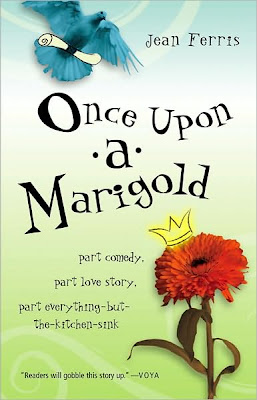
Jean Ferris is probably best known for Once Upon a Marigold and its sequel Twice Upon a Marigold, her updated fairy tales about a mind-reading princess, a runaway boy and the dwarf who cares for him, an evil queen, and the tooth fairy. However, Ms. Ferris has been around for quite a while and is deserving of a wider audience. Her fiction is wonderful for young adults and upper elementary kids -- full of humor and emotion and exiting action.

What I love most about Jean Ferris is her selection of quirky, screwball comedies. The two Marigolds fall into this category, as do Love Among the Walnuts and Much Ado About Grubstake. There's a quality to them that makes me think of John Irving (The World According to Garp); they are full of characters that in other novels would be hopeless misfits and yet in Ferris's stories they are valued individuals and important to the resolution of the story.

It's practically impossible to describe the plot of Love Among the Walnuts, other than to say that it involves a mental institution, a pair of evil uncles, and two people and a chicken who've been put in a coma. In Much Ado About Grubstake, 16 year old Arley has to outsmart a powerful businessman who is trying to buy up all the played-out mines in tiny, run-down Grubstake. That she has to manage this with a misfit collection of townspeople and reformed bad guys is part of the novel's charm.

Her comedies always bring together strange assortments of people with all their quirks and oddities and over the course of the story they manage to find family in each other. I love that about her work.


All of her comedies are suitable for younger readers -- say 3rd grade and up -- but would also work for older readers right through high school. They are great vocabulary stretchers, too, so much so that I had my 9 year old start making lists of words she wasn't sure about. She's probably added 50 new words to her vocabulary thanks to Jean Ferris.

Ferris also has some more serious novels and these would be more appropriate for a little older audience. Of Sound Mind is a fascinating book about a boy who is hearing but has been raised by deaf parents. Theo's role as family interpreter is explored even as it changes when his father has a stroke and his self-absorbed mother can't bear to take care of him. Once again, Ferris does a nice job of portraying people with all their warts, though this time with a more serious bent.

Into the Wind is part one of a three-part series which is more or less a romance for high schoolers, complete with an orphaned heroine and a dashing pirate who rescues her. It takes place in 1814, is loaded with action, and provides some historical detail, all in a wholesome, totally-appropriate-for-older-teens story (no bodice ripping here, folks).

Underground is another historical novel, this time exploring slavery. The main character, Charlotte, is a slave at the Mammoth Cave Hotel. When she discovers runaway slave sometimes come to the hotel on their way north, Charlotte has to decide whether she, too, will run away or stay with Stephen, another slave who doesn't feel the need or desire to leave. Another one which would be good for junior high and up.

Ferris does a wonderful job of creating memorable, original characters in compelling, entertaining stories. It's definitely work looking her up the next time you need reading material for your older kids.


Monday, November 15, 2010

Say What?


Does anyone else feel like they've been had on this one?

Anyone? Bueller? Bueller?

I willingly bought into (and bought) the 39 Clues books because my 4th grader loved them. My husband and I read them, too, and liked them, though they weren't the same caliber as the Percy Jackson and the Olympians series. I was pleased that Amy and Dan's adventures were able to end gracefully and coherently. Good closure and all that.

But now they're back. And I am not sure how I feel about that.

Wait -- I am sure how I feel about it: I feel like they're merely trying to extend a lucrative franchise, that it's less about compelling storytelling than it is about the cha-ching. And maybe I wouldn't feel like I'm being pumped for whatever else might be in my wallet if we hadn't already bought all the 39 clues books (oh yeah, all 10).

Hmmmm. Since I have a bad habit of mouthing of without a ton of thought beforehand, I'm going to officially state that BOOKIVORE RESERVES JUDGEMENT ON THE NEW VESPERS SERIES UNTIL SHE READS THE FIRST BOOK.

Then I'm going to remind myself when I get all twitchy and miffy and such that I have RESERVED JUDGEMENT.

Right. Glad we cleared that up.


NOTE: yes, I read about the "other, powerful family" in the last 39 Clues book, but for some reason I just didn't think they'd be starting a new series so soon after the first one. But I did grasp that there would be a new series. Truly, I are not so dumb.

Thursday, November 11, 2010

Literacy Bags


Literacy bags go by different names: Book Bags, Story Bags, and Book Buddies are just a few. The basic idea behind them, though, is to provide story enrichment activities around a particular theme. They can be used in the home or as part of literacy centers in the classroom. In the home setting, they help you, the parent, show your child that reading is both desirable and fun.

Literacy bags work well in preschool and kindergarten settings, and even in up to 3rd grade if the activities are carefully selected. Above and below are some pictures of the contents of a literacy bag my 4 year old brought home from preschool.
The book was Down By the Bay, which is based on the Raffi song by the same name. The literacy bag contained 3 types of activities: a matching activity with rhyming words, a puzzle activity, and a second rhyming activity that went beyond the rhymes in the book. The picture above is the first rhyming activity -- matching a picture with another picture that rhymes. We had a picture of a pear and a bear, a bat and a hat, and so on.


Then we had a set of very simple puzzles -- just line drawings of animals from the story cut into pieces and laminated. The final activity, below, was to come up with some objects from around the house and then think of words that rhyme with them. The theme here was "things that rhyme."


Another bag that she brought home the following week was for the book The Gingerbread Boy. This one was even more simple -- just the book and a selection of felt pieces depicting characters or objects necessary to the story.

We used the pieces to retell the story, then we used them to sequence the events of the story -- first the Gingerbread Boy met the cow, then the horse, then the farmer, then the fox. First he sat on the fox's tail, then his back, then his head, then his nose...and we moved the gingerbread boy each time to the right position.

If you are a homeschooler, or a teacher, or a parent volunteer, Literacy Bags are something you can make yourself. You could even throw some together for vacation days and summer activities if, like me, you are desperate for stuff your kids can do when there's no school. Below are a couple of resources for creating your own bags. Neither are in print anymore, but they are readily available from Amazon and Barnes and Noble's used book sellers and from Better World Books.


Also, here's a link to a teachers' discussion board with some interesting ideas for literacy bags (also math and science bags, though that's out of the scope of this blog). Some of the discussion assumes training in teaching methods, but several entries are basic, easy-to-apply suggestions.

Literacy bags are wonderful tools to make stories come alive, to help kids think more deeply about what happened in the story, to practice retelling and sequencing, and to build those connections that increase their chances of success in school.